

Business Insurance in Kenya: Complete 2026 SME Guide
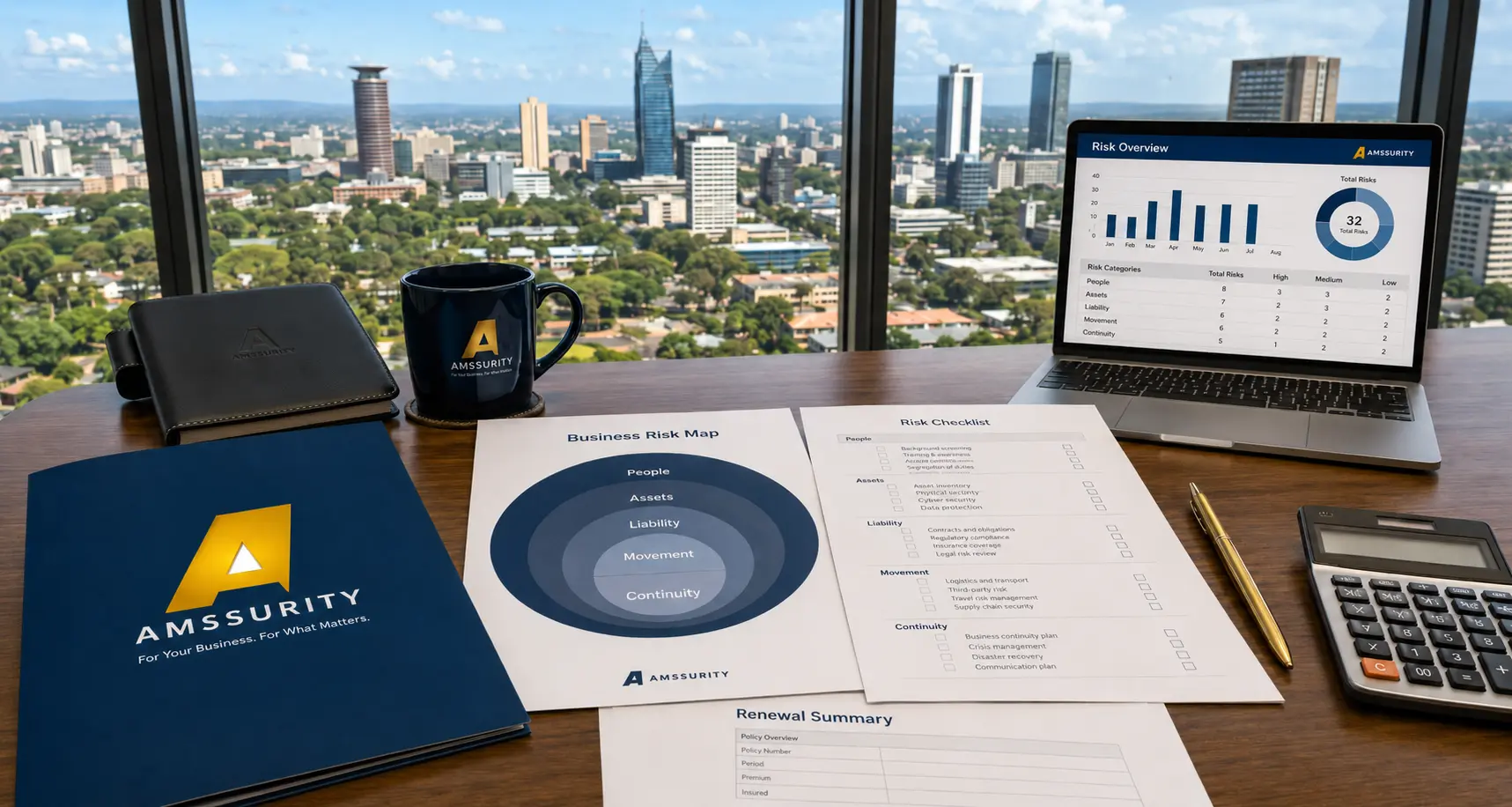
Business insurance is not one policy. It is a risk system.
Your SME may have insurance certificates for WIBA, motor, fire, burglary, and medical cover, and still be badly exposed.
The issue is usually not that the business forgot to buy insurance.
It is that the policies were bought one by one, renewed on autopilot, and never tested against how the business actually operates today.
A fire policy may repair damaged stock but fail to replace the income lost while the business is closed. A motor policy may cover the vehicle but not the goods being delivered. A WIBA policy may help address employee injury obligations but still leave wider employee, contractor, liability, and safety exposures unresolved.
That is why business insurance in Kenya should not be treated as a list of products.
For a serious SME, it should be reviewed as a business risk system.
Table of Contents
What business insurance does an SME in Kenya need?
A Kenyan SME should usually review business insurance across five risk areas:
| Risk area | Covers to review | Why it matters |
|---|---|---|
| People | WIBA, group medical, group personal accident, employer’s liability, directors and officers liability | Employees, directors, contractors, visitors, and customers create people-related risk. |
| Assets | Fire and perils, burglary, all risks, electronic equipment, machinery breakdown, money insurance | Stock, equipment, tools, buildings, office assets, cash, and machinery need accurate values. |
| Liability | Public liability, products liability, professional indemnity, contractors’ liability | A business can be legally responsible for injury, property damage, advice errors, product defects, or contract-related losses. |
| Movement | Commercial motor, goods in transit, marine cargo, travel cover | Vehicles, goods, field staff, and tools create risk outside the main premises. |
| Continuity | Business interruption, consequential loss, cyber, fidelity guarantee, key person cover | The real damage is often not the first loss. It is the income, trust, and operating capacity lost afterwards. |
The exact mix depends on your sector, contracts, payroll, assets, vehicles, stock values, client obligations, and the kind of loss that would stop your operations fastest.
What unreviewed SME insurance looks like at claim time
The example below is a composite, anonymised scenario built from recurring patterns Amssurity sees when reviewing SME insurance structures in Kenya. The figures are used to show how gaps appear at claim time; they should not be read as one identifiable client file.
A packaging materials manufacturer in Industrial Area, Nairobi. Twenty-eight employees — fifteen permanent production workers and thirteen casuals on weekly contracts.
The business had what most SMEs consider reasonable insurance: WIBA, fire and perils on stock and machinery, and comprehensive motor on two delivery vehicles. Three events in twelve months showed what the structure was actually worth.
Claim 1 — casual worker injury.
A casual worker on the production line suffered a crush injury to two fingers. Surgery and treatment at a Nairobi private hospital: KES 164,000. The WIBA insurer disputed the claim. The reason: the policy had been declared on permanent headcount and permanent payroll only. The casual workers were not reflected in the schedule. The employer paid KES 164,000 out of pocket.
Claim 2 — goods in transit.
One delivery vehicle was involved in an accident on Mombasa Road. KES 190,000 of finished goods being delivered to a client in Athi River was destroyed. The motor claim settled vehicle repairs at KES 67,000. The stock was not covered — goods-in-transit had never been added to the motor policy. The business absorbed a KES 190,000 loss on goods it had already manufactured and invoiced.
Claim 3 — fire and underinsurance.
An electrical fault caused a fire that damaged production equipment. The insurer agreed the loss. But the declared sum insured was KES 3.8 million. The actual replacement cost of the damaged equipment was assessed at KES 5.6 million. The assessed loss was KES 1.2 million.
Because the declared value represented only about 67.9% of the actual replacement value, the insurer applied average. The settlement reduced to approximately KES 814,000 against an assessed loss of KES 1.2 million.
Revenue lost during the forty-seven-day shutdown: not covered. No business interruption policy existed.
Three claims. Total uninsured loss before revenue loss: approximately KES 740,000. Add the forty-seven days of uninsured revenue interruption, and the real commercial loss was higher.
The business had not failed to buy insurance. It had bought insurance that was never structured, declared correctly, or reviewed against how the business actually operated.
For Kenyan SMEs reviewing their current cover
The certificate says you are covered. The schedule says something different.
Send us your current policy schedules — WIBA, fire, motor, liability, and medical. We compare what you have against what your business actually needs and identify the gaps before you renew. No premium table. A plain-English review of your current structure and where it may fall short at claim time.
If your current structure has gaps that will matter at claim time, we will identify them before you commit to another year of premiums.
The Amssurity SME Risk Stack
Most SMEs buy insurance by product name.
A better method is to review insurance by risk layer.
1. People risk
People risk includes employees, directors, contractors, suppliers, visitors, and customers.
| Cover | Purpose | Key checks |
|---|---|---|
| WIBA | Statutory cover for work-related injury, illness, or death. | Payroll accuracy, employee categories, casual workers, claim notification. |
| Group personal accident | Accident benefits for employees beyond WIBA. | Overlap and gaps with WIBA. Whether it complements or duplicates. |
| Employer’s liability | Legal liability for employer negligence outside WIBA. | Negligence trigger, exclusions, territorial limits, indemnity limit. |
| Group medical | Healthcare for employees and dependants. | Outpatient limits, maternity sublimits, chronic illness, hospital panel, renewal pricing. |
| Directors and officers liability | Claims against directors for management decisions. | Governance exposure, exclusions, retroactive date. |
Under Kenya’s Work Injury Benefits Act, every employer must obtain and maintain an insurance policy with an approved insurer for liabilities under the Act, unless exempted under the Act. The Act also requires employers to report workplace accidents to the Director within the prescribed timelines.
The payroll declaration gap — what competitors will not tell you.
WIBA exposure is not limited to permanent employees. Casual, seasonal, daily-rated, and contracted workers can create work-injury exposure depending on the employment arrangement and policy declarations.
Many WIBA policies, however, are priced and declared on permanent headcount and permanent payroll figures only. When a casual worker is injured and the policy schedule does not reflect the correct employee categories and payroll basis, the insurer may dispute or reduce the claim. The employer then faces the uninsured portion out of pocket — as the Industrial Area scenario above shows.
Before you renew your WIBA policy, confirm that every relevant category of worker — permanent, casual, seasonal, daily-rated, and contracted where applicable — is correctly reflected in the schedule and premium basis.
For SMEs with 20 or more persons employed at a workplace, workplace safety governance is not optional.
Kenya’s Occupational Safety and Health Act requires an occupier to establish a safety and health committee where there are twenty or more persons employed at the workplace, or where the Director directs that such a committee be established. This matters because WIBA insurance responds after a work injury or occupational disease, but the employer’s wider duty is to prevent and manage workplace risk before an accident happens. Insurance does not replace safety management. It responds to failures that safety management did not prevent.
Advisory point: WIBA should not be treated as the full employee-risk solution. It is one part of the people-risk layer.
2. Asset risk
Asset risk covers the physical things your business depends on.
| Business asset | Cover to review | Common gap |
|---|---|---|
| Building | Fire and perils | The landlord’s policy excludes your fittings, improvements, and contents. |
| Stock | Fire, burglary, stock declaration | A KES 800,000 declared value in January may be KES 2.2M by December. The shortfall comes out of your pocket. |
| Office equipment | Office package, all risks | Cover typically stops at the declared premises. |
| Machinery | Machinery breakdown | Fire cover excludes mechanical and electrical breakdown. Three weeks’ downtime can exceed KES 400,000. |
| Tools and portable equipment | Contractors’ plant, all risks | Tools used off-site are often undeclared entirely. |
| Cash | Money insurance | Limits set at inception are rarely updated. |
The key issue is not simply whether the business has cover.
The key issue is whether the sum insured reflects the real replacement value.
If stock, machinery, equipment, or fittings are understated, the insurer may apply average. In plain English, that means the insurer reduces the claim because the business insured only part of the risk. The Industrial Area fire claim above is a direct example of this.
3. Liability risk
Liability risk is about harm caused to other people, their property, their finances, or their legal rights.
| Cover | Best fit | Watch carefully |
|---|---|---|
| Public liability | Retail, restaurants, clinics, offices with visitors, warehouses, events. | Limit per event, aggregate limit, exclusions, and visitor exposure. A KES 500,000 limit is often inadequate for businesses with high daily visitor traffic or client assets on-site. |
| Products liability | Manufacturers, importers, distributors, food businesses, FMCG suppliers. | Product defect wording, recall exclusions, contamination, and territorial limits. |
| Professional indemnity | Consultants, accountants, architects, engineers, trainers, and IT firms. | Retroactive date, claims-made wording, and professional scope. Public liability does not cover professional negligence — PI has a separate trigger. |
| Contractors all risks | Contractors, fit-out firms, construction SMEs, project-based businesses. | Contract requirements often exceed the policy limit purchased. A KES 50M project requirement against a KES 10M policy leaves KES 40M uninsured. |
| Tenant liability | SMEs leasing offices, retail shops, warehouses, clinics, or workshops. | Lease obligations may be wider than the insurance purchased. |
The real question is not whether the business has liability insurance.
It is who could sue the business, what could trigger the claim, and whether the current limit would be enough.
4. Movement risk
Vehicles, goods, drivers, tools, and field staff create risk away from your premises.
| Risk | Cover to review | Common gap |
|---|---|---|
| Vehicle accident | Commercial motor comprehensive | Vehicle use class, unauthorised driver, excess, repair limits, towing, and tracking conditions. |
| Third-party road liability | Motor third-party | Legally compliant but often inadequate for the business exposure. |
| Goods damaged in transit | Goods in transit | Motor cover does not extend to the goods. A KES 300,000 load per run is uninsured without goods-in-transit cover. |
| Imported or exported goods | Marine cargo | Incoterms, documentation, valuation basis, and territorial limits are rarely reviewed. |
| Driver injury | WIBA / GPA | Driver employment status and benefit structure are unclear. |
| Tools used off-site | All risks / contractors’ equipment | Cover stops at the premises. |
Kenya’s Insurance (Motor Vehicles Third Party Risks) Act requires a compliant policy or security in respect of third-party risks before a motor vehicle is used on a road in Kenya, subject to the provisions of the Act.
Advisory point: A vehicle certificate does not automatically mean your goods, driver injury exposure, delivery obligations, or business downtime are properly protected.
5. Continuity risk
Continuity risk is what happens after the first loss.
This is where many SMEs are exposed.
A fire may damage stock. A burglary may remove equipment. A machine may fail. A cyber incident may interrupt operations. A dishonest employee may steal cash or inventory. A key person may become unavailable.
The first question is: what was lost?
The second question is more important: can the business keep operating?
| Continuity risk | Cover to review | Why it matters |
|---|---|---|
| Lost income after fire or insured damage | Business interruption / consequential loss | Protects income while the business recovers. A 47-day shutdown generates revenue loss the fire claim alone does not cover. |
| Machinery downtime | Machinery breakdown with business interruption extension | Where one machine failure can stop production entirely. |
| Cyber interruption | Cyber insurance | Relevant where systems, payments, or client data are business-critical. |
| Employee dishonesty | Fidelity guarantee | Where staff handle cash, stock, or client funds. |
| Death or disability of key person | Key person cover | Where one founder, director, or specialist is central to the business. |
Business interruption is often the missing piece.
A business may insure its assets and still fail to insure the income those assets produce.
Five insurance mistakes Kenyan SMEs make before a claim
| Mistake | Why it feels safe | What can go wrong |
|---|---|---|
| Treating WIBA as the full employee-risk solution | The employer has a certificate. | Employer liability, casual workers, contractors, and benefit gaps may still remain. |
| Buying fire cover without business interruption | The assets are insured. | Revenue can stop while rent, salaries, loans, and suppliers still need payment. |
| Insuring vehicles but not goods in transit | The truck has comprehensive cover. | The vehicle may be covered, but the stock inside may not be. |
| Relying on landlord insurance | The building is insured. | Your stock, fittings, equipment, improvements, and income may be excluded. |
| Buying liability cover with a low limit | There is a public liability policy. | The limit may be too low for the contract, premises, traffic, or worst credible claim. |
An insurance certificate proves the policy was bought. A claim will show whether it was bought well
For SMEs with 10–100 employees
Before you renew, know what your current structure is actually worth at claim time.
The Amssurity Benefit Scheme Audit reviews your business insurance as one structure — not five separate certificates bought at different times. You receive a written brief identifying gaps, duplications, weak limits, missing extensions, and contract risks. Not a verbal chat. A document you can act on.
The audit covers
- WIBA — all employee categories
- Motor and goods in transit
- Group medical and benefits
- Business interruption
- Fire, burglary, and assets
- Public and professional liability
- Machinery breakdown
- Contract insurance clauses
Format
90-minute session + written brief
Turnaround
Brief delivered within 48 hours
Cost
No charge. No obligation.
If a cheaper option will leave your business exposed at claim time, we will say so before you pay.
Business insurance in Kenya by SME type
Retail and wholesale businesses
| Risk | Covers to review |
|---|---|
| Stock fire or theft | Fire and perils, burglary, stock declaration. |
| Customer injury | Public liability. |
| Cash handling | Money insurance, fidelity guarantee. |
| Delivery exposure | Commercial motor, goods in transit. |
| Staff injury | WIBA, GPA, group medical. |
Common gap: Stock values change during peak seasons, but the policy limit remains the same. A retail business insuring stock at KES 800,000 in the off-season and carrying KES 2.2 million in stock at peak may face a significant underinsurance adjustment on a December burglary claim.
Restaurants, cafés, and hospitality SMEs
| Risk | Covers to review |
|---|---|
| Fire and kitchen hazards | Fire and perils, business interruption. |
| Customer injury or illness | Public liability, products liability. |
| Equipment breakdown | Machinery breakdown, electronic equipment. |
| Staff injury | WIBA, GPA, group medical. |
| Cash and fraud | Money insurance, fidelity guarantee. |
Common gap: The business has public liability, but food-related products liability is not clearly addressed. A customer illness claim linked to food served by the business can generate liability costs well beyond KES 500,000 depending on severity, treatment, and legal pursuit — and may sit outside a standard public liability policy wording.
Professional services firms
This includes consultants, marketing agencies, accountants, trainers, architects, engineers, legal-adjacent firms, IT firms, and advisory businesses.
| Risk | Covers to review |
|---|---|
| Bad advice, negligence, or professional error | Professional indemnity. |
| Client data exposure | Cyber insurance. |
| Employee benefits | Group medical, WIBA, GPA. |
| Office assets | Office package, electronic equipment. |
| Director exposure | Directors and officers liability. |
Common gap: The firm insures furniture and laptops but not the professional service or advice that creates the real claim exposure. A training firm that delivers a course that is later challenged as negligent by a corporate client may face a KES 1 million or more claim. Public liability does not respond to professional errors. Professional indemnity does.
Construction and contracting SMEs
| Risk | Covers to review |
|---|---|
| Project works damage | Contractors all risks. |
| Third-party injury or property damage | Public liability / third-party liability under CAR. |
| Employee injury | WIBA, GPA, employer’s liability. |
| Plant and machinery | Contractors’ plant and machinery. |
| Vehicles and transit | Commercial motor, goods in transit. |
| Contractual obligations | Review insurance clauses before signing. |
Common gap: The contractor signs a project contract requiring specific limits and extensions, then buys a generic policy that does not match the contract. A contract requiring KES 50 million CAR cover, third-party liability, and a thirty-six month defects liability period is not satisfied by a standard annual contractors’ policy purchased at a generic limit. The gap becomes the contractor’s direct liability if the client pursues a claim.
Manufacturing and processing SMEs
| Risk | Covers to review |
|---|---|
| Fire, explosion, flood, or storm | Fire and perils. |
| Machinery failure | Machinery breakdown. |
| Production downtime | Business interruption. |
| Product injury or defect | Products liability. |
| Employee injury | WIBA, GPA, employer’s liability. |
| Stock and raw materials | Stock cover, goods in transit, marine cargo. |
Common gap: The business depends on one or two critical machines but has no machinery breakdown or business interruption review. One critical machine failing mechanically for three weeks — not from fire but from an internal fault — may generate KES 400,000 or more in lost production revenue that sits entirely outside the fire policy.
Logistics, transport, and delivery SMEs
| Risk | Covers to review |
|---|---|
| Vehicle accident | Commercial motor. |
| Goods damage or theft | Goods in transit. |
| Driver injury | WIBA, GPA. |
| Third-party injury | Motor third-party liability and public liability where relevant. |
| Contract exposure | Review client transport agreements. |
Common gap: The motor policy is active but the cargo exposure is absent. A logistics SME making daily runs carrying goods worth KES 250,000 to KES 400,000 per load has an uninsured goods exposure on every delivery where goods-in-transit cover is not in place.
Which business insurance covers are mandatory in Kenya?
Not every business insurance cover is legally mandatory for every SME.
Some covers are legally required. Some are contractually required. Some are commercially necessary.
| Cover | Legal or commercial position | Practical note |
|---|---|---|
| WIBA insurance | Required for employers under the Work Injury Benefits Act, unless exempted under the Act. | Any SME with employees should treat this as a core compliance cover — with correct payroll declaration across all relevant employee categories. |
| Motor third-party insurance | Required for motor vehicles used on roads. | Commercial motor use should be correctly declared. |
| Professional indemnity | Often required by regulators, clients, tenders, or contracts in professional sectors. | A general liability policy does not replace PI. |
| Public liability | Often required by landlords, malls, clients, event organizers, and tender documents. | Limit should match the real exposure and contract. |
| Contractors all risks | Commonly required on construction, fit-out, and project contracts. | Match the policy to the project scope, contract period, and employer requirements. |
| Group medical | Usually not legally mandatory for all SMEs, but commercially important for retention and staff welfare. | Benefit design affects both cost and employee satisfaction. |
The Insurance Regulatory Authority is the statutory regulator established under Kenya’s Insurance Act to regulate, supervise, and promote the development of the insurance industry. Buyers can use IRA resources to check licensed insurers, agents, brokers, and other insurance entities.
How to compare business insurance quotes in Kenya
Do not compare SME insurance quotes by premium alone.
Compare them by claim outcome.
| What to compare | Why it matters |
|---|---|
| Sum insured | Is the value realistic and current? |
| Limit of liability | Is the limit enough for the worst credible claim? |
| Excess / deductible | What amount will the business pay before the insurer pays? |
| Exclusions | What is not covered? |
| Warranties and conditions | What must the business do for cover to remain valid? |
| Territorial limits | Where must the loss occur to be covered? |
| Business description | Does the policy match what the business actually does? |
| Employee category | Are casuals, contractors, drivers, and field staff treated correctly? |
| Claims procedure | What documents and timelines apply? |
| Contract requirements | Does the policy meet landlord, lender, client, or tender obligations? |
| Insurer claims handling | How does the insurer handle claims in practice? |
A cheaper quote may be adequate for a simple, low-risk business.
But for an SME with stock, employees, customers, vehicles, machinery, contracts, and debt obligations, cheap cover can become expensive at claim time.
Documents every SME should request before buying or renewing cover
Before you buy or renew business insurance, request:
- Policy schedule
- Full policy wording
- Endorsements and extensions
- Exclusions list
- Warranties and conditions
- Claims procedure
- Premium breakdown
- Asset schedule
- Vehicle schedule
- Employee and payroll schedule — with all relevant categories, including casuals where applicable
- Business interruption worksheet, where applicable
- Contract insurance requirements, where cover is tied to a client, landlord, lender, or tender
A quote is not enough. The policy wording is where the real answer sits.
The SME insurance audit checklist
Use this before renewal.
| Audit question | Why it matters |
|---|---|
| Has the business added new premises, branches, vehicles, machines, or stock? | New assets may not be covered automatically. |
| Has payroll changed — including casuals, contractors, and seasonal workers where applicable? | WIBA pricing and compliance may be wrong. |
| Has turnover changed? | Liability and business interruption exposure may shift. |
| Are stock values seasonal? | Underinsurance risk increases during peak periods. |
| Have you signed new client contracts? | The contract may require specific covers or limits. |
| Are employees working off-site? | Fieldwork, delivery, and client-site work change risk. |
| Do you use casuals or subcontractors? | Their status and categories must be handled correctly in your WIBA schedule where applicable. |
| Has the business taken loans? | Lenders may require specific asset or credit-related cover. |
| Do customers visit your premises? | Public liability may be essential. |
| Could operations stop after one machine, supplier, system, or vehicle fails? | Business interruption may need review. |
| Does any workplace have 20 or more persons employed? | If yes, check whether the safety and health committee requirement under OSHA applies and whether it is documented. |
If you cannot answer these questions quickly, your business insurance is probably being renewed from habit, not reviewed properly.
Red flags in SME business insurance
Watch these carefully.
- Your policies were bought one by one and have never been reviewed together.
- You only have certificates, not full policy wordings.
- Your stock value has changed but your sum insured has not.
- Your WIBA policy was declared on permanent employees only — casuals, seasonals, and daily-rated workers are not in the schedule.
- Your renewal discussion happens only a few days before expiry.
- Your insurer has an outdated business description.
- Your policy excludes the exact activity that now generates most of your revenue.
- You give professional advice but have no professional indemnity cover.
The problem is not always the insurer. Sometimes the policy was never given the right information.
How much does business insurance cost in Kenya?
The cost depends on your risk profile — sector, premises, assets, payroll, claims history, and the limits and extensions you need. A retail shop, a construction contractor, and a consulting firm should not be priced the same way.
Before you ask what insurance costs, know what the risk costs. A forty-seven day shutdown, a disputed WIBA claim, a fire that destroys KES 1.2 million of equipment , the premium looks different when you price it against what you are protecting.
For a worked SME example showing how payroll, asset values, turnover, limits and excesses affect the premium, read our guide to business insurance cost in Kenya.
When should an SME review its business insurance?
At minimum: before renewal, before signing a major client contract, before buying new machinery or vehicles, after a major claim or near miss, and whenever the main business activity changes.
A renewal should not be a date on the calendar. It should be a risk review.
How to choose an insurance advisor
Choose an advisor who can explain the policy, not just source the quote. If they only send a premium table, you are getting a quote comparison — not an insurance review.
Advisory verdict: the best business insurance is structured, not scattered
For a small SME with simple operations, a basic business insurance package may be enough.
For a growing SME with employees, stock, vehicles, contracts, customer interaction, machinery, credit obligations, or multiple locations, business insurance should be structured as a system.
The real test is not whether you have insurance certificates.
The real test is whether your covers work together when something goes wrong.
A good SME insurance structure should answer five questions clearly:
- What can stop the business from operating?
- What can create a legal claim against the business?
- What can injure employees, customers, contractors, or the public?
- What can damage assets, stock, vehicles, machinery, tools, or goods?
- What can damage cash flow even after the physical loss is repaired?
If your current policies do not answer those questions, it is time for an audit.
Amssurity Insurance Agency · IRA-licensed agent
Most SMEs do not need more policies.
They need a clearer view of the risks they already carry.
Two ways to start — choose the one that fits where you are now.
If you know your structure needs a review
Book a Free Benefit Scheme Audit
90 minutes. A written brief within 48 hours. We review your WIBA, group medical, fire, motor, liability, and continuity cover as one structure and give you a plain-English gap summary — not a pitch.
Book a Free Audit →Written brief within 48 hours · No obligation
If you want to compare your options first
Compare Business Insurance in Kenya
Send us your current policy schedules and we identify the gaps, duplications, and cover areas to address before you renew. A written summary of where your structure stands — not a premium table.
Compare My CoverIRA-licensed advisor · Plain-English review
Frequently asked questions about business insurance in Kenya
Plain-English answers to the questions Kenyan SME owners ask most before renewal.
What is business insurance in Kenya?
Business insurance in Kenya is not one policy — it is a risk system. WIBA, fire, motor, liability, group medical, and business interruption are separate covers that should be reviewed together, not bought separately and forgotten.
What insurance does a small business need in Kenya?
Most SMEs should review WIBA, fire and perils, burglary, public liability, commercial motor, goods in transit, group medical, and business interruption. The right mix depends on your sector, employees, assets, and contracts — a logistics firm and a consulting firm carry very different risks.
Is WIBA insurance mandatory in Kenya?
Yes. Under the Work Injury Benefits Act, every employer must maintain a policy covering liabilities under the Act. The policy must reflect all worker categories — permanent, casual, seasonal, and daily-rated — not just permanent headcount. A policy declared on permanent employees only may not pay when a casual worker is injured.
Is motor insurance mandatory for business vehicles in Kenya?
Yes. No vehicle should be used on a road without a compliant third-party policy. Commercial use must be declared correctly — and a vehicle certificate does not mean your goods in transit, cargo liability, or driver injury exposure are covered.
Does fire insurance cover business interruption?
Not automatically. Fire insurance covers physical damage — not the income you lose while you are closed. That requires a separate business interruption or consequential loss policy.
Does my landlord’s insurance cover my business assets?
Usually not. A landlord’s policy covers the building structure. Your stock, equipment, fittings, improvements, and trading income are your responsibility to insure separately.
What is public liability insurance?
Public liability protects your business against claims from third parties — customers, visitors, suppliers, contractors — for injury or property damage linked to your premises or operations. The limit matters: a low limit may be inadequate for the volume of people or value of assets on your site.
What is professional indemnity insurance?
Professional indemnity protects businesses that give advice, consultancy, or professional services against claims for errors, negligence, or professional mistakes. It is a separate trigger from public liability — a PI claim arises from the quality of your advice, not physical injury or property damage.
How often should an SME review business insurance?
At minimum, before every renewal. Also before signing new contracts, buying machinery, increasing staff, or moving premises. If any workplace reaches 20 or more employees, review your safety committee obligations under the OSH Act at the same time.
How do I compare business insurance quotes in Kenya?
Compare limits, exclusions, excesses, warranties, employee declarations, and whether the policy description matches what your business actually does. Do not compare premiums alone — cheap cover at the wrong limit will cost more at claim time than the premium you saved.
Still unsure which covers apply to your business? The answers above are a starting point — the detail sits in your schedule, wording, and exclusions. Request a free Benefit Scheme Audit and we will review your current structure in plain English before your next renewal.
Source and review note
Author: Amssurity Insurance Agency
Reviewed by: Agnes Mukulu, Licensed Insurance Advisor
Last updated: June 2026
Source basis: Kenya insurance legislation, IRA resources, insurer policy wordings, SME advisory experience, and Amssurity’s insurance audit framework.
This guide is for general insurance education and should not replace a review of your specific policy wording, contracts, schedules, exclusions, and insurer terms. Benefits, limits, exclusions, and legal requirements may change. Always confirm the current position before buying, renewing, or relying on cover.
Amssurity Insurance Agency — IRA-licensed insurance agency — Nairobi, Kenya

Founder & Insurance Advisor | Amssurity Insurance Agency, an IRA-licensed agency in Nairobi
Agnes Mukulu advises individuals, families, SMEs and diaspora Kenyans on health, motor, business, life and international medical insurance. Having reviewed hundreds of policies, quotations and benefit schedules, she helps clients look beyond premiums to understand benefits, exclusions, waiting periods, excesses and claims requirements. She founded Amssurity to make insurance guidance clearer, more transparent and more practical, helping clients choose suitable cover and understand how it should work when they need it most.