
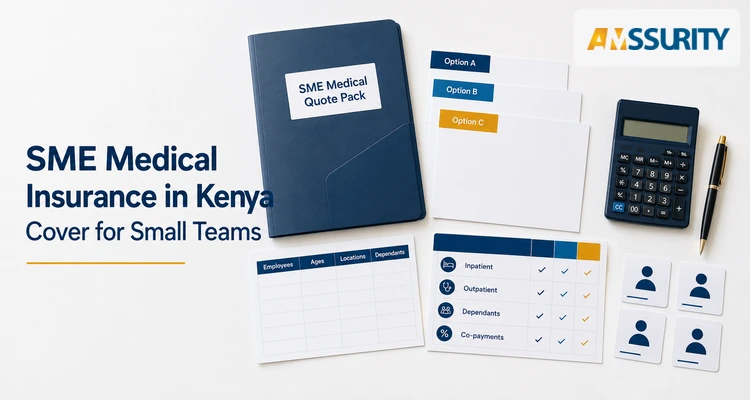
SME Medical Insurance in Kenya: How Small Employers Can Cover Their Teams
You do not need to employ hundreds of people before your business can investigate staff medical cover.
Some SME medical insurance products in Kenya are designed for small registered businesses. The real question is whether the eligibility rules, benefits and likely renewal cost fit the business you are building.
Sometimes called SME health insurance or SME group health cover, is arranged by a business for eligible employees and, where selected, their dependants.”
This guide explains how SME medical insurance in Kenya works, what determines the premium and what a small employer should compare before committing.
Table of Contents
What is SME medical insurance?
SME medical insurance is health cover arranged by a business for eligible employees and, where selected, their dependants. It normally starts with inpatient treatment and may extend to outpatient care, maternity, dental, optical and chronic-condition treatment. The benefit limits, exclusions, co-payments and approval requirements determine what the insurer will actually pay.
SME cover also sits between two other arrangements:
| Arrangement | How it normally works | When to investigate it |
|---|---|---|
| Individual or family policies | Each employee or household buys separate cover. | Very small teams that do not meet group eligibility requirements. |
| SME medical insurance | A packaged group product with defined limits and eligibility requirements. | Small and growing businesses seeking a manageable staff benefit. |
| Corporate group medical scheme | A more customised scheme with benefit categories, reporting and wider design choices. | Larger businesses or employers with more complex workforce requirements. |
A packaged SME product can suit a small workforce, while a corporate scheme may become more suitable as employee numbers and benefit needs grow.
How many employees are needed for SME medical insurance in Kenya?
There is no single minimum number across the market. Each insurer and product applies its own eligibility and underwriting rules.
The practical range is usually 3 to 100 employees, depending on the insurer and product. Jubilee J-Biz publicly accepts registered businesses from three members, while Old Mutual SME Health Cover caters for groups of 3 to 100 employees.
These limits are product-specific, so businesses should confirm eligibility, participation requirements and dependant rules before requesting quotations. Companies with only one or two employees may need individual medical policies or a specially arranged small-group solution.
Use team size as a starting point rather than the final decision:
| Your team | Practical route to investigate |
|---|---|
| 1–2 people | Check whether individual or family policies are more practical. |
| 3–9 employees | Investigate packaged SME medical products and their minimum-member requirements. |
| 10–20 employees | Compare SME products with selected group or corporate arrangements. |
| More than 20 employees | Consider whether greater customisation and separate benefit categories are required. |
The insurer may also check business registration, employee participation, the existing scheme, member ages, locations and dependant requirements.
How much does SME medical insurance cost in Kenya?
There is no reliable universal price per employee. Inpatient-only cover for employees will not price like family cover with outpatient and maternity benefits.
The main cost drivers include:
- Number and ages of members. The employee census affects the risk being priced.
- Who the company covers. Employee-only cover costs differently from employee-plus-family cover.
- Inpatient limit. Higher annual limits generally increase the premium, but smaller limits still need examination.
- Outpatient structure. The limit, provider network, co-payments and access rules affect cost and employee experience.
- Maternity, dental and optical benefits. These may be optional, restricted to specific members or subject to separate limits.
- Chronic and pre-existing conditions. Cover may be included, capped, restricted or subject to declared underwriting terms.
- Hospital access. Broader or higher-cost provider access can affect pricing and co-payment requirements.
- Claims experience. An existing scheme’s utilisation and claims history may influence renewal pricing and benefit design.
A useful quotation begins with a census and benefit brief, not a request for “your cheapest package.” Otherwise, two premiums may be solving different problems.
Which benefits should a small employer prioritise?
Start with how employees are most likely to use healthcare, not with every available add-on.
Inpatient cover is normally the foundation. Check whether the limit applies per person or family and which treatments sit under smaller caps.
Outpatient cover is the benefit employees use most frequently. Examine consultations, diagnostics, medicine, specialist referrals, co-payments and accessible facilities.
Maternity, dental and optical benefits add value where the workforce is likely to use them and the limits are meaningful.
Chronic and pre-existing-condition provisions require careful reading. Confirm the sublimit and whether medication, specialist reviews and diagnostics sit within it.
The strongest SME medical plan is not necessarily the one with the longest benefit list. It is the one whose main benefits, smaller limits and access rules fit the workforce and the employer’s budget.
Should an SME cover employees only or include dependants?
This is an employee-benefits design decision, not merely an insurance selection.
An employer can fund employees only, include selected dependants, or provide a base benefit while employees pay for dependants or upgrades. Each approach changes cost and administration.
Before including dependants, confirm family definitions, entry ages, newborn rules, underwriting requirements and what happens when an employee leaves.
Do not promise family cover to staff before testing the full cost. Removing a valued dependant benefit at the next renewal can be more disruptive than starting with a sustainable employee-only structure and expanding it deliberately.
What information is needed to request SME medical quotations?
Prepare the following before approaching insurers or an advisor:
- Registered business name and business documents.
- Number of employees to be covered.
- Employee ages, gender and work locations.
- Dependant ages and relationships, where family cover is required.
- Preferred hospitals or geographical access needs.
- Required inpatient, outpatient and additional benefits.
- Intended commencement date.
- Current benefit schedule and claims information for an existing scheme.
- A realistic annual budget or employee-contribution policy.
Complete information produces more comparable quotations and reduces late eligibility questions.
How should SMEs compare medical insurance quotations?
Compare each quotation against the same workforce and benefit brief. Then examine:
- Minimum-member and business-eligibility rules.
- Inpatient and outpatient limits.
- Maternity, dental, optical and chronic-condition sublimits.
- Co-payments, excesses and employee out-of-pocket costs.
- Hospital network and regional access.
- Pre-authorisation and referral requirements.
- Rules for joiners, leavers, newborns and dependants.
- Premium-payment arrangements.
- Claims and escalation support.
- What information will be available before renewal.
If you are comparing insurer names or available SME products, use our separate guide to group and SME medical insurance companies in Kenya.
Once quotations arrive, our group medical insurance comparison guide explains how to review the underlying benefit schedules.
Does private SME medical insurance replace SHA?
No. Private staff medical cover and the employer’s statutory Social Health Authority responsibilities should be treated as related but separate matters.
The SHA Employer Portal provides employer registration and contribution functionality. Confirm current obligations through official SHA guidance and professional advice where necessary.
Private SME cover provides additional healthcare benefits. It should not be presented as a substitute for statutory compliance.
Five mistakes small employers should avoid
1. Choosing by premium alone
A lower price may reflect narrower benefits or greater employee contributions.
2. Treating the hospital list as the cover
A listed hospital may still apply co-payments, approval rules or benefit restrictions.
3. Ignoring employee geography
A strong Nairobi network may be impractical for employees working elsewhere.
4. Promising benefits before confirming the terms
Communicate limits, access and employee costs accurately.
5. Waiting until renewal to review the scheme
Record employee complaints, access problems and difficult claims during the year so renewal decisions are based on evidence.
SME medical insurance in Kenya can start small, but it should still be designed with growth in mind. A structure that works for five employees may need different benefit categories, reporting and renewal controls when the team reaches 30 or 50.
Compare the SME medical structure before your business commits.
Get matched SME medical insurance options and a plain-English comparison of eligibility, premium, inpatient and outpatient benefits, dependants, smaller limits, co-payments, hospital access and claims support.
Buying SME medical insurance for the first time or replacing an existing scheme? Start with the same employee census so the options can be compared on an equal basis.
General education only. Eligibility, premiums, benefits, provider access, exclusions, statutory obligations and policy terms vary by insurer, scheme and date. Confirm current terms in the applicable quotation, benefit schedule, policy wording and official statutory guidance before making a decision.
By Agnes Mukulu, Amssurity Insurance Agency
Last reviewed: 18 July 2026

Founder & Insurance Advisor | Amssurity Insurance Agency, an IRA-licensed agency in Nairobi
Agnes Mukulu advises individuals, families, SMEs and diaspora Kenyans on health, motor, business, life and international medical insurance. Having reviewed hundreds of policies, quotations and benefit schedules, she helps clients look beyond premiums to understand benefits, exclusions, waiting periods, excesses and claims requirements. She founded Amssurity to make insurance guidance clearer, more transparent and more practical, helping clients choose suitable cover and understand how it should work when they need it most.