
Best Family Medical Insurance in Kenya: How to Compare Cover Before You Buy in 2026
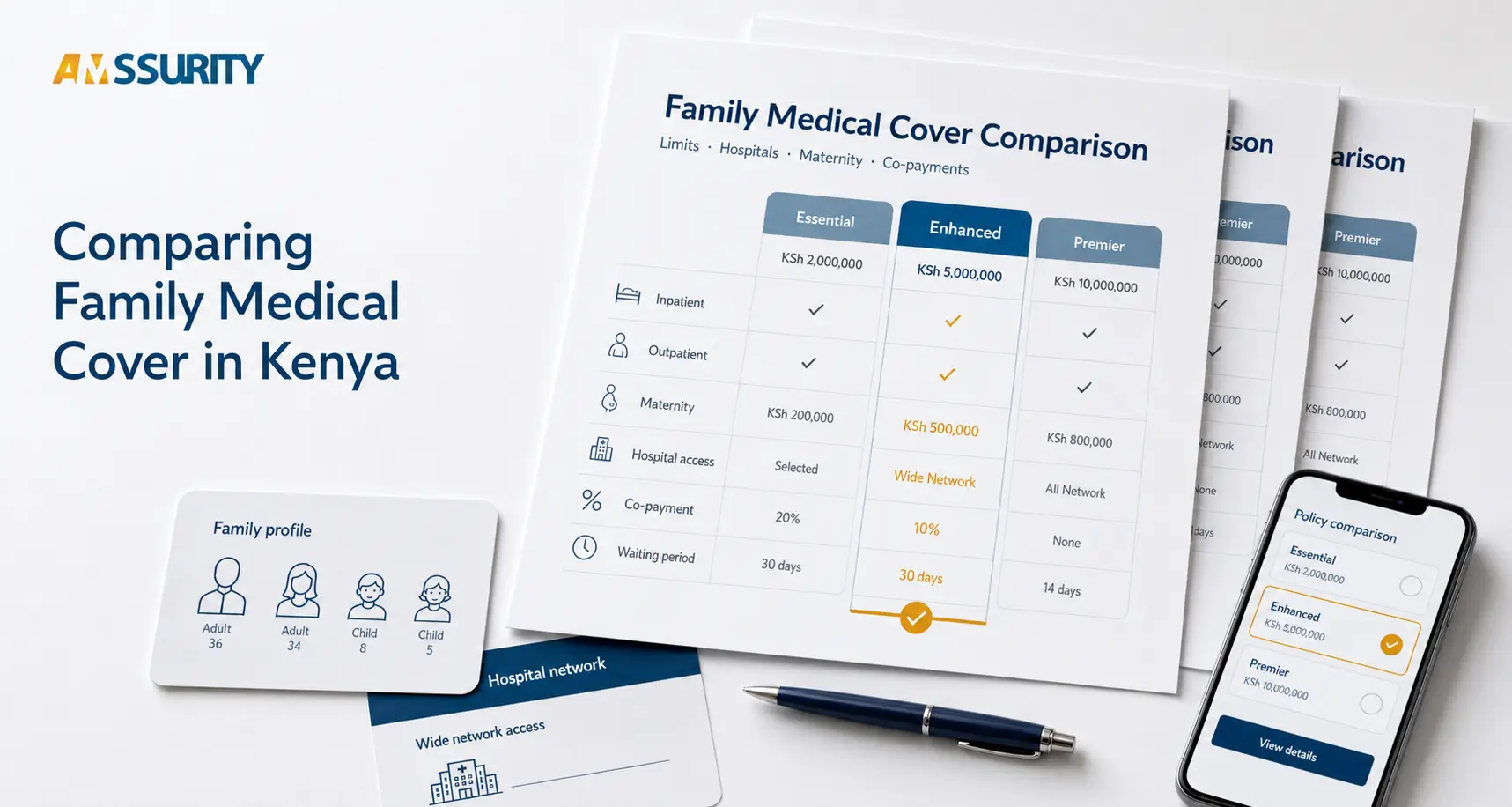
Family medical insurance in Kenya is often compared using the annual premium, hospital list and inpatient limit.
That is only part of the decision.
A family medical policy may need to support regular child outpatient visits, specialist consultations, maternity planning, emergency admission, ongoing treatment or a change in employment cover.
Those needs do not always sit under one benefit limit or follow one payment process.
To compare family health insurance in Kenya properly, you need to check how the cover fits your household’s likely use of care, where you expect to receive treatment and how much medical cost you are prepared to carry yourself.
When my family uses this cover, what will the insurer pay, what might we pay, and what needs approval first?
Table of Contents
How to compare family health insurance in Kenya before you buy
Start with the household you have now, not a generic idea of what a family policy should provide.
A young child may use outpatient care more often than either parent. One adult may need regular specialist follow-up. You may be planning maternity within the next year or two. Your family may also have strong preferences about hospitals, clinics, location or the experience of admission.
Those details determine which benefits deserve close attention.
| Household question | Why it matters when comparing family health insurance |
|---|---|
| Who will be covered, and what are their ages? | Eligibility, pricing, child-care needs and future benefit fit can differ across household members. |
| Which hospitals and outpatient clinics does the family genuinely use? | A long provider list is less useful than confirming the actual facilities your family expects to rely on and how the policy pays there. |
| How often does the family use outpatient care? | Regular consultations, medicines, tests and follow-up appointments can make outpatient limits and co-payments commercially important. |
| Is maternity planning relevant within the next 12 to 24 months? | Waiting periods, maternity limits, delivery terms and hospital arrangements need to be assessed before timing becomes urgent. |
| Does anyone require specialist, chronic or recurring follow-up care? | The policy should be tested for definitions, approvals, limits, underwriting conditions and continuity of care. |
| How much medical cash can the household reasonably absorb? | This determines whether co-payments, excesses, sublimits and self-funded gaps are deliberate trade-offs or a household budget risk. |
Start here before comparing premiums. A family policy should fit the household’s actual care pattern, not only the quote summary.
A policy can look competitive on a quotation and still be a poor fit for the way your family actually uses care.
Compare before you choose
Compare family health insurance in Kenya with Amssurity Insurance.
Get instant family health insurance quotes, then check the details that matter: hospital fit, sublimits, co-payments, waiting periods and approval conditions.
Use the instant quote path for quick options. Use WhatsApp if you want a plain-English Family Quote Pack.
Use the “who needs care most?” test
The most useful way to compare family medical insurance in Kenya is to test each option against the family member most likely to need care.
That may be:
- The child who sees a doctor more often.
- The parent planning maternity.
- The adult with recurring specialist appointments.
- The family member whose preferred hospital or clinic matters most.
- The person whose health needs could expose a waiting period, approval rule, sublimit or co-payment.
A policy may look attractive for the healthiest adult in the household while creating avoidable friction for the person most likely to use it.
Ask this question before you choose cover:
If the family member most likely to need care uses this policy next year, will the cover still feel deliberate, workable and financially manageable?
The answer may still lead you to a lower-premium plan. It may also justify paying more for a better hospital route, stronger outpatient access, lower cost sharing or a more suitable maternity structure.
The point is to make the differences in needs to be visible before the family medical insurance cover is needed.
The six checks that determine whether family medical insurance cover will work
1. Hospital and care pathway
A hospital list is useful.
Check where your family expects to go for:
- Routine outpatient consultations
- Child-care needs
- Specialist appointments
- Emergency treatment
- Planned admission
- Maternity care, where relevant
Then ask how the policy pays at those facilities.
A facility may be available under a policy while the claim experience still depends on benefit limits, pre-authorisation, co-payment requirements, referral rules or reimbursement processes.
The family comparison should therefore go beyond the hospital list
It should answer:
“When my family uses this hospital, how does the policy work?”
2. Inpatient structure and the sublimits inside it
A large inpatient limit does not automatically mean every family need sits within that amount.
Review the benefit schedule for smaller limits, separate categories and conditions that may affect the household.
Depending on the policy, these can include maternity, outpatient, diagnostics, dental, optical, chronic care, cancer-related treatment, emergency transport or another defined benefit category.
The key issue is not whether a policy has a large headline inpatient number.
The biggest concern should be on the benefit your family is most likely use, where does it sit inside that headline limit or is under a separate cap or behind a specific condition.
3. Outpatient and paediatric use
For many households, outpatient use becomes the regular touchpoint within the family medical cover.
Children may need consultations, tests, medicines and follow-up care more often than adults. Adults may also need GP access, specialist consultations, diagnostics or repeat prescriptions.
When you compare family health insurance, check:
- Consultation limits and payment rules
- Prescription medicine treatment
- Diagnostic and laboratory benefits
- Specialist referral requirements
- Co-payments for common outpatient services
- Whether preferred clinics fit the policy’s care route
A family can be comfortable with a lower outpatient structure if it uses care rarely and has cash available for smaller routine costs. Another household may need a more predictable outpatient arrangement because regular care is part of its reality.
4. Maternity and newborn planning
Maternity planning should be treated as a timing decision, not an afterthought.
Before buying or renewing, confirm:
- Whether maternity is included, excluded or separately structured
- The relevant waiting period
- The maternity benefit limit
- Delivery and hospital conditions
- Any approval or provider-route requirements
- The process and timing for adding a newborn to the policy
- Any conditions that could affect continuity of cover after birth
A family planning maternity in the near future should not assume that a medical policy purchased today will automatically respond as expected later.
Read the current benefit schedule and policy wording. Ask for a written explanation of the timing, waiting-period and benefit structure that applies to the specific option being considered.
5. Co-payments and household cash exposure
Premium is only one cost in a family medical decision.
The second cost is the cash the household may need to contribute when it uses care.
This may arise through:
- Co-payments
- Excesses
- Sublimits
- Costs above a stated benefit cap
- Reimbursement differences
- Services outside the policy’s defined route
- Excluded items or conditions
A lower premium can be sensible when the family understands and can absorb the remaining exposure. It becomes risky when the policy shifts cost back to the household in situations where the family expects full or near-full support.
Before selecting a plan, be clear about where the policy stops and the household’s financial responsibility begins.
6. Approvals, dependant additions and continuity
Family life changes. The cover should be reviewed with those changes in mind.
Ask:
- Which services require pre-authorisation?
- Are specialist visits subject to a referral pathway?
- What happens when a child, spouse or newborn is added?
- Are there timing rules for adding dependants?
- What happens when employer cover changes or ends?
- How might underwriting, a change in health status or renewal affect continuity?
- Which administrative requirements could delay or complicate a claim?
These questions matter because a family policy is not simply purchased once and forgotten. It is a working arrangement that needs to remain suitable as the household changes.
The family medical benefit-schedule checklist
Before you compare family health insurance in Kenya, ask for the current benefit schedule and work through the questions below.
- Is the policy limit structured per person, per family, shared across members or in another way?
- Which benefits have separate caps, including maternity, outpatient, chronic care, diagnostics, dental, optical or other categories?
- How do co-payments apply to consultations, medicines, tests and specialist visits?
- Which treatments require referral, pre-authorisation or a defined provider route?
- What waiting periods and underwriting conditions apply to maternity, pre-existing conditions or other relevant needs?
- How does the plan pay at the hospitals and clinics your family expects to use?
- What is the process for adding a newborn, spouse or another eligible dependant?
- Which exclusions, definitions or administrative conditions could materially change the claim experience?
A brochure gives the headline. The schedule shows how the policy works.
Before you decide
Need a plain-English comparison before you choose family cover?
Send the current benefit schedule or quotation and ask for a Family Quote Pack. We will help you identify the hospital fit, sublimits, co-payments, waiting periods and approval conditions that deserve attention before you pay.
No obligation. Suitability depends on the current benefit schedule, policy wording and underwriting outcome.
How to compare family health insurance quotes side by side
A responsible comparison should make the trade-offs visible, not simply present three premiums.
Use this structure when comparing family medical insurance options.
| Compare this | What to look for | Why it matters to the family |
|---|---|---|
| Annual premium | Total annual cost and payment structure | Shows the direct cost, but does not explain the full claim-time exposure. |
| Preferred hospital and clinic route | Actual facilities the family expects to use and the payment process there | Determines whether the plan supports the family’s practical care habits. |
| Inpatient structure | Inpatient limit, admission conditions, room rules and relevant sublimits | A headline limit may not tell the full story of the benefits inside the policy. |
| Outpatient and paediatric access | Consultations, medicines, tests, specialist access and co-payments | Often affects the family’s recurring use of care. |
| Maternity and newborn fit | Waiting periods, benefit limits, delivery terms and dependant-addition rules | Timing can materially affect whether the policy fits the family’s plans. |
| Cost sharing | Co-payments, excesses, reimbursement differences and self-funded gaps | Shows the medical cash exposure the family may still carry. |
| Approval pathway | Referrals, pre-authorisation and required provider routes | Can affect convenience, timing and the claim experience. |
| Advisory verdict | The strongest fit, the pros & cons for each and who each option suits | Turns policy information into a decision a household can actually make. |
Use this table to compare the benefit schedule, not only the quotation. The premium shows cost; the schedule shows how the policy behaves when the family needs care.
The right recommendation may be:
- A lower-premium option with understood cost sharing.
- A stronger outpatient option for a family with frequent child-care use.
- A maternity-focused option for a household with a defined timeline.
- A more flexible hospital pathway for a family with specific facility preferences.
- A recommendation to wait, change direction or avoid a policy that does not fit the real requirement.
A good advisor should be comfortable explaining when an option is not right for your household.
Where SHA fits into a family medical decision
SHA is relevant to Kenyan households. A private family medical policy should still be assessed on its own terms.
For any option you are considering, confirm the private policy’s:
- Hospital and clinic route
- Benefit schedule
- Approval requirements
- Provider arrangements
- Co-payments and household exposure
- Terms that apply to the specific care your family is likely to need
Having SHA and having private medical insurance are two separate parts of the family’s health-financing position. The practical question remains the same:
For this treatment, at this facility, under this policy, what is paid and what might the household still need to carry?
For current SHA benefits, contribution rules, provider arrangements or regulatory updates, rely on the latest official guidance and the applicable policy documentation before making a decision.
Family medical cover is a renewal decision too
A renewal is the best time to compare family health insurance again.
Your household does not stand still for a year. A child may be older. Your preferred hospital may have changed. Maternity planning may now be relevant. A parent may need more regular specialist care. Employer cover may have changed. The policy itself may have different limits, pricing, conditions or provider arrangements.
Before renewing, ask:
- Has our family composition changed?
- Are we still using the same hospitals and clinics?
- Has outpatient use increased?
- Is maternity planning now relevant?
- Has anyone developed an ongoing care need?
- Do we understand the current co-payments and sublimits?
- Are there policy changes that affect the claim pathway?
- Does the current cover still suit the household we are now?
Renewal should be treated as a fresh family decision, not a payment exercise.
What a responsible family medical recommendation should give you
A responsible family recommendation should do more than show you three premium figures.
It should explain:
- Why one option is stronger for your family’s outpatient use
- Which hospitals and clinics fit each option
- Whether maternity timing is compatible with the policy structure
- Which sublimits are likely to matter to your household
- How co-payments could affect your medical cash exposure
- Which approvals or provider conditions could affect treatment
- What each option gives you, and where it may fall short
- When none of the available options is a good fit
That is the standard to expect before buying, changing or renewing cover.
Family Quote Pack
Compare family health insurance in Kenya with Amssurity Insurance.
Choosing family medical insurance should leave you clear about what each option covers well, what it may limit, and what your household may still need to pay for.
Plain-English explanation. No obligation. Final suitability depends on the current benefit schedule, policy wording and underwriting outcome.
Frequently asked questions
Questions families ask before comparing health insurance
What should a family compare in medical insurance?
Compare the hospital and care pathway, inpatient structure, outpatient and paediatric use, maternity timing, waiting periods, sublimits, co-payments, approval requirements and the process for adding dependants. Premium is one part of the decision. The schedule shows the rest.
How do I compare family health insurance in Kenya?
Start with your household’s likely use of care. Identify the preferred hospitals and clinics, the family member most likely to need treatment, outpatient use, maternity plans, specialist needs and the cash exposure you can carry. Then compare every quotation against the current benefit schedule.
Is a family plan better than separate individual medical policies?
It depends on the specific product structure, eligibility, pricing and the household’s needs. A family arrangement can be practical, but it should not be assumed to be better without comparing the actual schedules, limits, cost-sharing structure and dependant rules.
What is the best family medical insurance in Kenya?
The best option depends on your household’s ages, preferred hospitals, outpatient use, maternity plans, medical needs, budget and tolerance for out-of-pocket costs. A good fit is the policy that makes the relevant trade-offs visible and remains workable when the family member most likely to use care needs treatment.
When should a family review medical cover?
Review cover before purchase, at every renewal and whenever the family changes. Key triggers include a new child, maternity planning, a change in employment cover, new specialist-care needs, a different hospital preference or a change in the policy’s benefits or payment terms.
These answers are for general guidance. Always check the current benefit schedule, policy wording and underwriting terms before relying on any medical cover.
Compare family medical insurance in Kenya with Amssurity Insurance today. Get instant quotes online today.
General education only. Family medical insurance benefits, exclusions, provider access, statutory obligations, premiums and policy terms vary by insurer, scheme and date. Confirm current terms in the applicable benefit schedule, policy wording, insurer documentation and statutory guidance before making a decision.
By Agnes Mukulu, Amssurity Insurance Agency
Last reviewed: 8 July 2026

Independent Insurance Agent, IRA-Licensed | Amssurity Insurance Agency, Nairobi.
Agnes has reviewed hundreds of health insurance policies and benefit schedules for individuals, SMEs, and diaspora Kenyans. She founded Amssurity to give Kenyans the kind of honest insurance guidance that is rare in a commission-driven industry.