

Group Medical Insurance Companies in Kenya: A Practical Employer Comparison Guide 2026
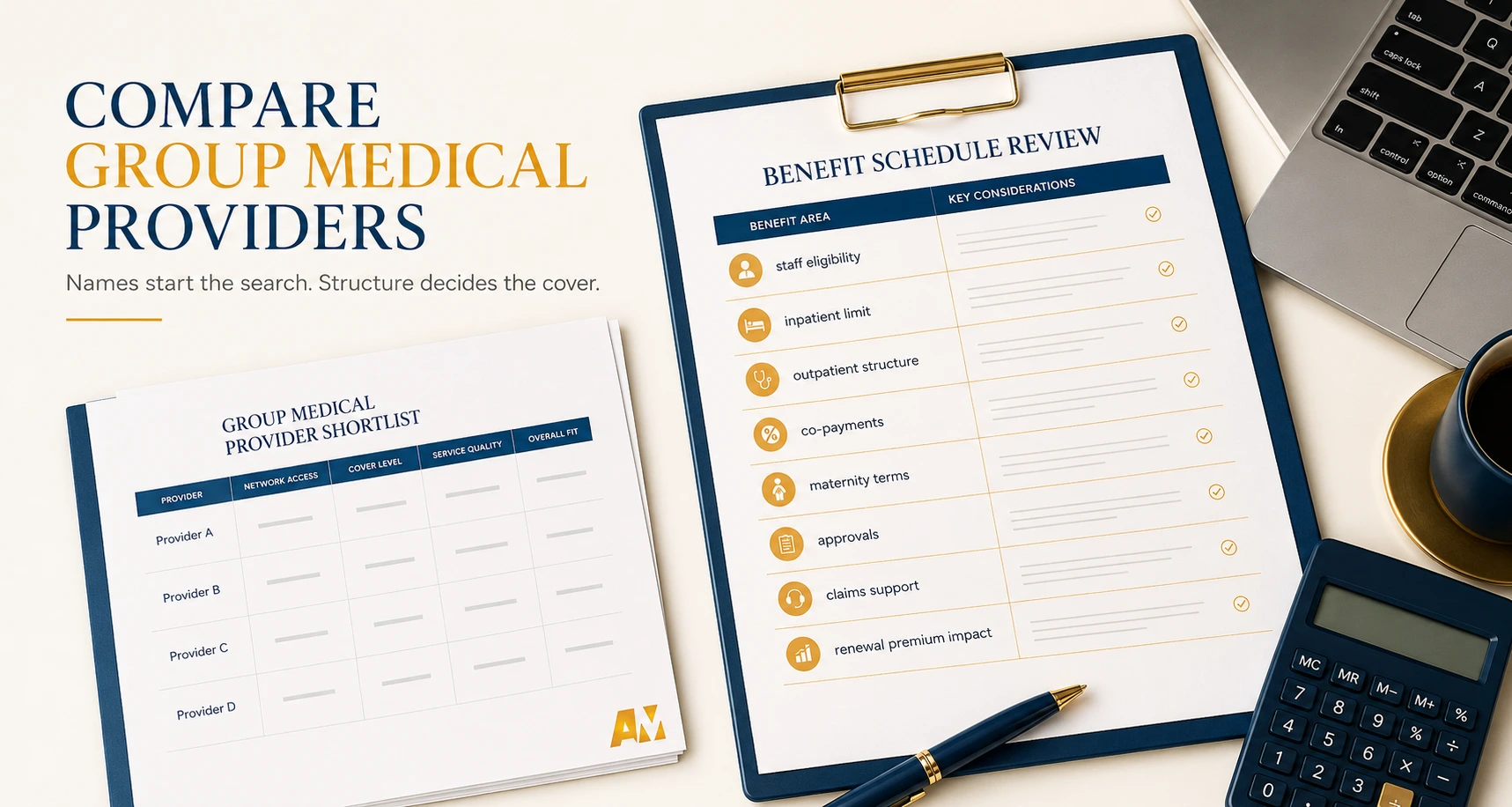
Many Kenyan employers search for group medical insurance companies in Kenya because they want names.
Names matter. But they are not enough.
A provider name only tells you where to start. It does not show how the cover will behave when employees begin using it.
A group medical scheme affects who qualifies for cover, which hospitals employees can access, what they may still pay themselves, what HR has to manage during approvals or claims, and what may happen to the premium after a heavy claims year.
This guide lists some of the insurance companies that publicly offer group, SME, corporate or organised- group health insurance in Kenya. It also shows what employers should check before requesting or approving a quotation for their group health insurance covers.
For a deeper employer checklist, read our guide on group medical insurance in Kenya and what to check before buying or renewing cover .
This is not a ranking of the “best” group medical insurance companies in Kenya. Group medical cover should be compared by employer size, benefit structure, hospital access, claims process, employee needs and what may happen at renewal.
Product details change. Always confirm the current quotation, benefit schedule, provider panel, exclusions, waiting periods and policy wording before relying on any cover.
Table of Contents
Quick Answer: Group Medical Insurance Companies in Kenya
Some of the companies with publicly available group, SME, corporate or organised group medical insurance information in Kenya include:
Some insurers and medical cover providers publicly offer group, SME, corporate or organised-group medical insurance options in Kenya. Use this table as a starting point, then compare the benefit schedule behind each quotation.
| Company / Provider | Public product positioning | Employer or group situation to investigate |
|---|---|---|
| Jubilee Health Insurance | Lists J-Biz SME, Corporate Health Cover and JubiAfya for SMEs, corporates, SACCOs, chamas, welfare groups and community groups. | SMEs, larger employers and organised member groups. |
| Britam | Offers Milele Corporate for employees and dependants, with eligibility stated for companies, NGOs and chamas with more than 10 members. | Employers, NGOs and chamas that need flexible benefit design. |
| APA Insurance | Offers corporate health products for groups with 10 or more employees, with inpatient cover as the main benefit. | SMEs and corporates comparing group-based medical cover. |
| Old Mutual | Lists SME Health Cover and Group Medical Standard Cover for business medical expenses. | SMEs and employer groups seeking business medical cover. |
| Madison Insurance | Offers Betterlife SME Insurance with adjustable cover levels, including publicly shown inpatient options from KSh 200,000 to KSh 5,000,000. | SMEs that want adjustable benefit levels. |
| Liberty / Heritage | Describes medical cover for companies, SMEs, public sector organisations and expatriate employees. | Employers with corporate, SME, public sector or expatriate staff needs. |
| AAR Insurance | Lists Business Enterprise Medical Plan and SME Medical for businesses building employee and family medical schemes. | SMEs and businesses comparing employee medical scheme design. |
| CIC Insurance Group | Lists SME Medipack under business solutions and Corporate Medisure under corporate solutions. | SMEs, corporates and cooperative-linked groups. |
| Fidelity Shield Insurance | Lists Fidelity Afya Shield SME and Fidelity Corporate Cover under its medical solutions. | SMEs and employer groups that need current benefit details before comparison. |
This is not a ranking. Product details change, so employers should confirm the current quotation, benefit schedule, hospital panel, exclusions, waiting periods, approval rules and claims process before choosing cover.
This list is not exhaustive. It is a practical starting point for employers who want to compare group medical insurance companies in Kenya without turning the decision into a simple premium contest.
Have the provider names? Now compare the structure behind them.
Send us the group medical options you are considering. We will help you check staff eligibility, benefit limits, hospital access, co-payments, approval rules and claims support before you request final quotations.
Useful when you have names but need help knowing which questions to ask before quotations.
How to Use This List Before Requesting Quotes
A list of companies is useful only if it helps you ask better questions.
Do not start by asking:
“Who is cheapest?”
Start by asking:
- How many employees do we need to cover?
- Are dependants included?
- Do we need inpatient only, or inpatient plus outpatient?
- Do we need maternity, dental, optical or chronic illness benefits?
- Which hospitals matter to our team?
- What will employees still pay through co-payments, excesses or uncovered items?
- What needs pre-authorisation before treatment?
- How will claims be handled?
- What might happen at renewal if claims are high?
The wrong group medical provider is not always the expensive one. Sometimes the real problem is a cover structure that looks acceptable on a quotation but becomes frustrating when employees begin using it.
Group Medical Insurance Companies in Kenya for Small SMEs and Growing Teams (2-9 Employees)
For a small employer, the first issue is eligibility.
Some insurers may require a minimum number of employees or members before they can quote. Others may offer SME-specific products with simplified structures.
Jubilee Health: J-Biz SME Medical Cover
Jubilee’s J-Biz SME Medical Cover is publicly positioned for registered business groups from 3+ members. The inpatient cover range between KSh 250,000 and KSh 10 million, with optional outpatient, maternity, dental and optical add-ons.
This may be relevant for smaller businesses that want to begin offering staff medical cover before they become a large corporate scheme.
What to check:
- Is your business eligible under the current underwriting rules?
- Are dependants allowed?
- Are outpatient, maternity, dental and optical automatic or optional?
- Which benefits have sublimits?
- What waiting periods, if any, apply to new members?
- How are chronic, psychiatric, congenital or pre-existing conditions handled?
Madison: Betterlife SME Insurance
Madison Betterlife SME Insurance is positioned around flexibility. Employers can start with basic option within budget or opt for a more comprehensive approach. The page publicly shows inpatient cover options from KSh 200,000 to KSh 5,000,000.
This may suit employers who need a more adjustable SME structure rather than a one-size-fits-all plan.
What to check:
- How many employees are required to qualify?
- Can the business create different benefit categories?
- Are outpatient, maternity, dental and optical included or optional?
- Are there medical underwriting requirements for older members?
- How does the provider handle mid-year additions and exits?
Old Mutual: SME Health Cover
Old Mutual lists SME Health Cover for business medical, dental, vision and maternity expenses.
This may be relevant for employers that want a recognised insurer with a dedicated SME medical proposition.
What to check:
- What benefits are core and what benefits are optional?
- Does the plan allow dependant cover?
- What is the hospital panel?
- Are there co-payments at selected facilities?
- How does the claims process work for outpatient treatment?
AAR: SME Medical and Business Enterprise Medical
AAR describes SME Medical as allowing businesses to build medical schemes for employees and their families, with inpatient, outpatient, maternity, dental and optical options. AAR also lists Business Enterprise Medical Plan for business and staff medical insurance.
This may be worth reviewing for employers that want a provider with a medical-service-heavy brand presence.
What to check:
- Whether the arrangement is structured as fully insured, administered or hybrid.
- Which facilities are available for outpatient access.
- Whether employees must use selected clinics or panel facilities.
- What approval rules apply for diagnostics, specialist visits, admissions or maternity.
- How reimbursements are handled if an employee uses a non-panel provider.
Fidelity Shield Insurance: SME and Corporate Medical Cover
Fidelity Shield Insurance lists Fidelity Afya Shield SME and Fidelity Corporate Cover under its Medical Solutions section. These options should be reviewed using the current quotation, benefit schedule and provider panel.
This may be worth considering for SMEs or employer groups that want to compare Fidelity alongside other medical insurance providers.
What to check:
- What is the minimum number of employees or members required?
- Is the cover available for employees only, or employees plus dependants?
- Are inpatient, outpatient, maternity, dental and optical benefits included or optional?
- Which hospitals are on the current panel?
- Are there co-payments, excesses or reimbursement-only facilities?
- What services require pre-authorisation?
- Who supports the employer and employees when claims, admissions or discharge issues arise?
APA: Corporate Health Cover for Groups from 10 Employees
APA offers flexible tailor-made corporate health products for groups with 10 or more employees. It also states that the main benefit is a fully insured inpatient scheme.
This may be relevant for SMEs that have already grown beyond a very small team and need a more corporate-style medical arrangement.
What to check:
- Does outpatient operate as insured, fund-managed or optional?
- How are maternity, dental and optical handled?
- What level of customisation is possible?
- Are there claims utilisation reports?
- What happens at renewal if claims are high?
Group Medical Cover for Larger Employers and Corporates
Larger employers need more than a quote. They need a scheme structure.
Once an employer has multiple staff levels, dependants, senior management needs and regular claims utilisation, group medical cover becomes a benefits-management decision.
Jubilee Corporate Health Cover
Jubilee Corporate Health Cover is publicly described as designed for businesses, corporates and groups with 21 employees and above.
This may fit employers that have outgrown smaller SME medical products and need a wider corporate structure.
What to check:
- Can benefit categories be separated by staff grade?
- What is the inpatient and outpatient structure?
- Are there wellness, chronic care or disease-management benefits?
- What reporting does the employer receive?
- How are high-cost claims handled before renewal?
Britam Milele Corporate
Britam Milele Corporate is described as corporate medical cover offering inpatient cover and fund-managed outpatient cover for employees and dependants. Britam states that the cover is flexible and allows employers to choose expenses to be catered for.
This may be suitable for employers who want more flexibility around staff benefits and outpatient structure.
What to check:
- How is the outpatient fund managed?
- What reports does the employer receive during the year?
- Are benefits pooled or allocated per person?
- Are dependants handled under the same structure as employees?
- What claims controls are in place?
Old Mutual Group Medical Standard Cover
Old Mutual’s Group Medical Standard Cover is positioned as a business group medical solution covering medical expenses incurred by the assured in the event of ailment.
This may be relevant for employers comparing corporate group medical schemes.
What to check:
- What benefits are included under the standard structure?
- Can the scheme be customised?
- What provider panel applies?
- What exclusions and waiting periods apply?
- What is the renewal review process?
Liberty / Heritage Medical Cover
Liberty Kenya describes its Medical Cover as flexible healthcare solutions for companies, SMEs, public sector organisations and expatriate employees. It references options such as Heritage Flexi and the Blue Health Cover suite.
This may be relevant for employers with mixed staff profiles, public sector arrangements or expatriate employee needs.
What to check:
- Which plan level fits the staff group?
- Are expatriate employees covered locally, regionally or internationally?
- Are chronic conditions and specialist care adequately handled?
- What hospital network applies?
- How are reimbursements and approvals managed?
CIC Corporate Medisure
CIC’s public website lists Corporate Medisure under corporate solutions and SME Medipack under business solutions.
This may be relevant for employers who want to compare CIC’s corporate or SME medical offering against other group medical options.
What to check:
- Request the current product brochure and benefit schedule.
- Confirm eligibility and minimum staff numbers.
- Confirm whether outpatient, maternity, dental and optical are included.
- Review the provider panel.
- Ask for claims and renewal terms before approving.
Group Medical Cover for Chamas, SACCOs, Welfare Groups and Associations
Group medical insurance is not only for employers.
Some organised groups also look for medical cover for members. These may include chamas, SACCOs, welfare associations, community-based organisations and religious or professional groups.
Jubilee JubiAfya
Jubilee describes JubiAfya as group medical cover designed for welfare groups, SACCOs, chamas and community-based organisations. The page mentions flexible inpatient and outpatient limits, including maternity, chronic care and emergency support.
This may be relevant where a group wants medical protection for members without being a traditional employer.
What to check:
- What type of group registration is required?
- What is the minimum and maximum number of members?
- Are dependants allowed?
- Are benefits per member or pooled?
- What happens when members join or leave during the year?
- Are older members, pre-existing conditions or chronic conditions treated differently?
Britam for Chamas, NGOs and Registered Groups
Britam states that registered companies, NGOs and chamas with more than 10 members are eligible for its medical insurance cover.
This may be relevant for organised groups that want to compare options beyond employer-only schemes.
What to check:
- What documentation proves group eligibility?
- Are benefits the same for all members?
- How are contributions collected?
- What happens if some members default?
- What are the waiting periods and exclusions?
Group Medical Options for NGOs, Public Sector and Expatriate-Heavy Employers
Some employers have more complex medical-cover needs.
An NGO, public sector institution or expatriate-heavy employer may need to think beyond standard inpatient and outpatient benefits.
For example, Liberty Kenya specifically mentions companies, SMEs, public sector organisations and expatriate employees in relation to its medical cover. Britam also lists NGOs as eligible for its corporate medical cover.
For this kind of employer, the key questions are:
- Do employees travel frequently?
- Are expatriates covered under a local Kenyan medical panel only?
- Is evacuation cover needed?
- Are reimbursement claims common?
- Are dependants based in Kenya or outside Kenya?
- Does the cover work across the geography of the employer’s operations?
- Should the employer consider international private medical insurance for selected staff?
This is where an employer should be careful. A local group medical scheme may work well for Kenya-based employees but may not be enough for internationally mobile staff.
What Employers Should Compare Across All Providers
The provider name is only one part of the decision. The benefit schedule is where the real comparison happens.
Before approving a group medical quotation, compare the following areas.
1. Inpatient limit
The inpatient limit is the headline figure many employers notice first.
But a high inpatient limit does not automatically mean the scheme will work well. Some benefits may sit under smaller sublimits. Some hospitals may require co-payments. Some treatment may need pre-authorisation.
Ask:
- What is the inpatient limit per family or per person?
- Are there inner limits?
- Are ICU, HDU, surgery, cancer and specialist care treated differently?
- Are pre-existing and chronic conditions included?
- What exclusions apply?
2. Outpatient structure
Outpatient is where many employees feel the cover most often. A scheme can have a strong inpatient limit but weak outpatient access that creates staff complaints.
Ask:
- Is outpatient insured or fund-managed?
- What is the outpatient limit?
- Are consultations, lab tests, radiology and medication included?
- Are specialists covered?
- Are employees limited to selected providers?
- Is there a co-payment?
3. Maternity
Maternity can create major employee satisfaction issues if it is misunderstood.
Ask:
- Is maternity included?
- What is the waiting period?
- What is the normal delivery limit?
- What is the caesarean section limit?
- Are antenatal and postnatal services included?
- Are newborn complications covered?
- What happens if an employee joins while already pregnant?
4. Dental and optical
Dental and optical benefits often look attractive in a quotation, but they may have small limits and specific exclusions.
Ask:
- Are dental and optical included?
- What are the limits?
- Are frames, lenses, root canals, extractions or specialist procedures covered?
- Are there waiting periods?
- Are dependants included?
5. Chronic and pre-existing conditions
This area needs careful review because it affects real families and high-utilisation employees.
Ask:
- Are chronic conditions covered?
- Are pre-existing conditions covered?
- Are they covered immediately or after a waiting period?
- Are there sublimits?
- Does the insurer require medical declarations?
6. Co-payments and excesses
A hospital may be on the panel and still create employee out-of-pocket costs.
Ask:
- Which facilities attract co-payments?
- Is the co-payment fixed or percentage-based?
- Does the co-payment apply to outpatient, inpatient or both?
- Are there special rules for high-cost hospitals?
- Will employees know this before they visit the facility?
7. Pre-authorisation
Pre-authorisation is not an admin detail. It can change the claim experience.
Ask:
- Which services require approval before treatment?
- Who obtains the approval: the hospital, insurer, broker, employer or member?
- How long does approval take?
- Is emergency admission handled differently?
- What happens if treatment begins before approval?
8. Hospital panel
A hospital list matters, but it is not the whole cover.
Ask:
- Are the hospitals your employees actually use on the panel?
- Are there tiered hospitals?
- Are some facilities reimbursement-only?
- Are some facilities subject to co-payment?
- Are paediatric, maternity and specialist facilities available where your employees live?
9. Claims support
The claims process can shape employee perception more than the benefit table.
Ask:
- Is there a clear claims escalation process?
- Who helps employees when admission, discharge or approval is delayed?
- Are claim forms and documents simple?
- How are reimbursements submitted?
- How quickly are claims paid?
10. Renewal behaviour
Renewal is where weak scheme design becomes visible.
Ask:
- What claims data will the employer receive before renewal?
- How is renewal pricing calculated?
- What happens if claims are high?
- Can benefits be adjusted without disrupting staff?
- Are there ways to manage utilisation before renewal pressure becomes severe?
Already have group medical quotes? Review the trade-offs before you approve.
We compare the quotation against the benefit schedule so you can see what the premium may hide: sublimits, co-payments, maternity terms, outpatient structure, approvals, exclusions and hospital access rules.
Send the quotation and benefit schedule. The schedule is where the real comparison usually sits.
Provider names help you build a shortlist. The next step is comparing the structure behind each quotation. For the full checklist, see our guide on what employers should check before buying or renewing group medical insurance in Kenya .
Common Mistakes Employers Make When Choosing Group Medical Insurance
Mistake 1: Choosing by premium alone
A lower premium can be sensible.
But it can also mean the risk has moved somewhere else: smaller sublimits, tighter provider access, co-payments, exclusions or a weaker outpatient structure.
Do not only ask what the cover costs. Ask what has been removed, limited or controlled to reach that price.
Mistake 2: Comparing hospital lists instead of benefit schedules
A hospital list tells you where employees may go.
The benefit schedule tells you what the insurer will actually pay.
A hospital can be on the panel while still requiring approval, co-payment or reimbursement processing.
Mistake 3: Ignoring employee usage patterns
If your employees mostly need outpatient care, paediatric care, maternity support or chronic medication, a scheme that looks strong on inpatient alone may disappoint them.
The right scheme should match how the team actually uses healthcare.
Mistake 4: Not communicating the scheme clearly to staff
Employees should understand:
- where they can go;
- what they need to carry;
- what needs approval;
- what may require co-payment;
- what is not covered;
- who to contact when stuck.
A good scheme can still frustrate staff if the communication is poor.
Mistake 5: Waiting until renewal to review claims experience
By renewal, the insurer already has the claims experience.
If the employer has not monitored utilisation during the year, renewal negotiation becomes reactive.
A better approach is to review the scheme quarterly or mid-year, especially where the staff headcount is growing or claims are rising.
When Should an Employer Use an Insurance Broker or Advisor?
An employer should consider using an insurance broker or advisor when:
- comparing more than one insurer;
- renewing after a difficult claims year;
- adding dependants;
- creating staff benefit categories;
- managing senior staff expectations;
- handling expatriate or internationally mobile employees;
- checking whether outpatient should be insured or fund-managed;
- trying to reduce premium without damaging the scheme;
- dealing with employee complaints about hospitals, approvals or reimbursements.
The broker’s role should not be merely to collect quotations.
A good advisor should help the employer compare the structure behind the quotation: limits, sublimits, co-payments, exclusions, approvals, claims process and renewal risk.
How to Compare Group Medical Quotations Properly
When quotations come in, do not place them side by side and only compare the premium.
Use this order:
Step 1: Confirm eligibility
Check whether your business or group qualifies under each provider’s rules.
Step 2: Compare the benefit schedule
Review inpatient, outpatient, maternity, dental, optical, chronic care, cancer, specialist care and emergency benefits.
Step 3: Compare what employees may pay themselves
Look for co-payments, excesses, reimbursement rules, facility restrictions and exclusions.
Step 4: Compare the hospital panel
Do not only ask whether a hospital is listed. Ask how access works at that hospital.
Step 5: Compare claims support
Ask who helps when admission, discharge, approval or reimbursement becomes difficult.
Step 6: Compare renewal risk
Ask what happens after a high-claims year and whether the scheme can be adjusted without creating employee frustration.
The Company Name Matters. The Structure Matters More.
It is useful to know which companies offer group medical insurance in Kenya.
But the provider name is only the start.
The real decision sits in the benefit schedule, claims process, hospital access rules, co-payments, approval requirements and renewal behaviour.
A group medical scheme should not only look acceptable on a quotation. It should work when employees need care, when claims begin, and when the business reaches renewal.
Before you approve cover, compare the structure behind the premium.
Before approving a group medical quotation, compare the cover beyond the provider name. Our detailed guide on group medical insurance in Kenya explains how to review benefits, co-payments, sublimits, approvals, claims support and renewal terms.
Before you buy or renew group medical cover, check how it will work in use.
Get advisory help comparing provider options, benefit limits, outpatient structure, maternity terms, co-payments, approvals, hospital access, claims support and renewal terms before your business commits.
No pressure. No confusing jargon. We help you see the structure before you approve the premium.
Amssurity Insurance is a group medical insurance specialized insurance agency that helps employers and HRs compare group medical insurance covers across all insurance companies.
General education only. Group medical benefits, exclusions, provider access, statutory obligations, premiums and policy terms vary by insurer, scheme and date. Confirm current terms in the applicable benefit schedule, policy wording, insurer documentation and statutory guidance before making a decision.
By Agnes Mukulu, Amssurity Insurance Agency
Last reviewed: 9 July 2026

Founder & Insurance Advisor | Amssurity Insurance Agency, an IRA-licensed agency in Nairobi
Agnes Mukulu advises individuals, families, SMEs and diaspora Kenyans on health, motor, business, life and international medical insurance. Having reviewed hundreds of policies, quotations and benefit schedules, she helps clients look beyond premiums to understand benefits, exclusions, waiting periods, excesses and claims requirements. She founded Amssurity to make insurance guidance clearer, more transparent and more practical, helping clients choose suitable cover and understand how it should work when they need it most.