

Medical Insurance for Parents in Kenya: 7 Costly Traps
When buying medical insurance for parents in Kenya, the goal is not simply to find the biggest inpatient limit. The right cover is one your parent can still join, your family can sustain, and the policy can realistically respond under when healthcare is needed.
A plan may advertise millions of shillings in benefits and still leave the family paying for a known condition because of a waiting period, sublimit, co-payment or provider restriction. Start with your parent’s actual healthcare pattern—not the brochure headline.
Already holding quotations? Ask for the full benefit schedules before comparing premiums. The important differences are often below the headline limit.
Table of Contents
First check: is your parent eligible to join?
There is no universal age at which someone enters a “senior” medical plan. Current insurer pages illustrate how widely the rules differ:
| Insurer and product | Advertised eligibility | How the senior option is structured |
|---|---|---|
| Britam Milele Elderly Parent | From 55 years | Dedicated elderly-parent route |
| CIC Seniors Mediplan | 60–80 years | Dedicated seniors plan |
| APA Jamii Plus | Adults up to 80 years | Senior age bands within the comprehensive Jamii Plus plan |
| APA Afya Nafuu | Adults up to 80 years | Senior age bands within the more affordable Afya Nafuu plan |
| AAR Seniors CAARE | 65–85 years | Dedicated seniors plan |
| Jubilee J-Senior | 65–79 years | Dedicated seniors plan |
| Old Mutual AfyaImara Seniors | 65–80 years | Dedicated seniors plan |
Important: These are market illustrations, not product rankings. Entry age does not guarantee acceptance. Eligibility, medical requirements, benefits, waiting periods and renewal terms should be confirmed against the insurer’s current quotation and policy documents.
These are market illustrations, not rankings. Eligibility can still depend on medical reports, underwriting and written acceptance. Benefits and age rules can also change, so confirm them against the current quotation and policy schedule.
When comparing medical cover for parents in Kenya, do not search only for products labelled “senior.” Some insurers offer dedicated senior plans, while others accommodate older applicants within broader medical plans and senior age bands.
What to Check Before Buying Medical Insurance for Parents in Kenya
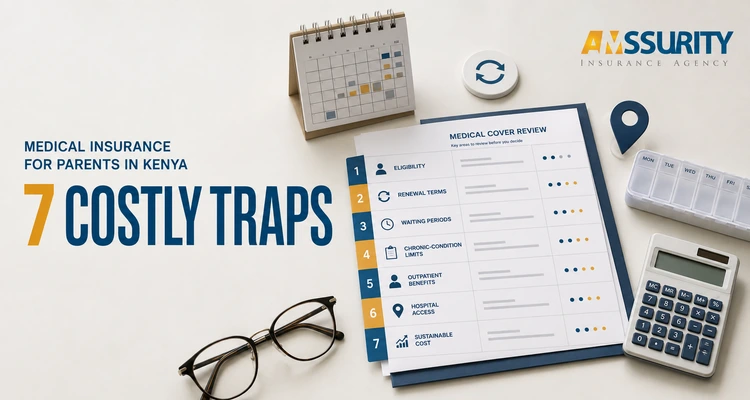
A policy can look suitable on paper yet leave costly gaps when your parent needs treatment. Before buying, use the seven checks below to assess the cover beyond the headline premium and benefit limits.
1. Waiting until treatment is already needed
A new policy is not a retrospective hospital-payment solution. If your parent already has a diagnosis, symptoms or planned treatment, disclose it fully and establish what the proposed policy would cover immediately, later or not at all.
Buying quickly without resolving those questions can create false confidence. Non-disclosure may also affect a later claim, so the medical history should be completed accurately even when it increases underwriting questions.
2. Confusing entry age with renewal age
“Can join up to age 80” and “can remain covered after age 80” are different promises. CIC, for example, advertises entry from 60 to 80 and continued renewal without an age limit. AAR advertises entry from 65 to 85 with lifetime renewability subject to renewal review.
Ask for both the maximum joining age and the renewal wording. Then confirm what happens if the policy lapses and the parent needs to apply again at an older age.
3. Assuming pre-existing conditions are covered immediately
“Pre-existing conditions covered” may still mean “covered later and within a sublimit.”
Britam currently states a 12-month waiting period for pre-existing and chronic conditions. AAR also states one year. CIC lists one year for pre-existing and chronic conditions, but two years for cancer treatment.
The exact wording varies by plan, but the lesson is constant: covered does not necessarily mean covered now or up to the full inpatient limit.
Request the waiting period, annual sublimit and applicable inpatient and outpatient rules in writing.
4. Choosing by the headline inpatient limit
A KSh 5 million inpatient limit is not automatically KSh 5 million for cancer, dialysis, joint replacement, home nursing or long-term chronic treatment. These benefits may have separate sublimits, waiting periods, session caps or pre-authorisation rules.
Compare the claim your parent is most likely to face—not merely the largest number on the quotation.
5. Underestimating routine outpatient use
Routine care is especially important when assessing health insurance for elderly parents in Kenya. For a parent managing hypertension, diabetes or another recurring condition, consultations, laboratory tests and medication may affect the family budget more frequently than hospital admission.
Consider a 72-year-old parent taking monthly medication. A large inpatient limit offers comfort, but it does not solve a shallow outpatient benefit, an excluded medicine or a chronic-condition wait. A lower headline limit with more usable routine-care benefits may fit that parent better.
6. Treating the hospital list as guaranteed access
A hospital appearing on the provider panel does not answer every access question. The relevant branch may sit in a different provider category, attract a co-payment, require a referral or need pre-authorisation for scans, surgery or specialist care.
Check the exact hospital and branch your parent uses, the outpatient co-payment, specialist pathway and cashless admission process. Reconfirm the panel before purchase because provider arrangements change.
7. Buying a premium the family cannot sustain
Senior medical premiums generally rise with age, benefits and underwriting risk. A strong policy becomes useless if the family cannot renew it.
Test affordability over three to five years, not only the first payment. Ask how premiums change by age band, whether instalments are available and what happens to continuity or waiting-period credit after a lapse.
The cheapest first-year option is not a bargain if it must be abandoned at renewal.
When private senior medical insurance may not solve the immediate problem
This is the uncomfortable but necessary part: private cover may not be the first answer when treatment is already imminent, the known condition faces a long waiting period, or the premium would consume the cash reserve needed for excluded expenses.
Before paying, do five things:
- Confirm the parent’s active SHA status and applicable benefits.
- Map the expected consultations, medication and treatment costs.
- Separate what the private policy covers immediately from what is delayed or excluded.
- Preserve cash for co-payments, sublimit gaps and non-covered treatment.
- Buy private cover only when it adds protection the family can realistically use and maintain.
SHA administers the Social Health Insurance Fund and the Emergency, Chronic and Critical Illness Fund. Private insurance can complement that protection through different benefits or provider access; it should not be presented as automatically replacing it.
The Ministry of Health’s 2026 tariff update should also be checked when assessing current public benefits.
The Amssurity verdict
The best senior medical insurance in Kenya is not one product for every parent. It is the option that passes three tests:
- Joinable: The parent’s age and medical history can be accepted.
- Usable: The waiting periods, sublimits, outpatient benefits and hospitals match the likely healthcare needs.
- Sustainable: The family can renew the cover without sacrificing the reserve needed for gaps.
If your parent is currently well, buying before options narrow can be sensible. If treatment is already planned, first build an immediate funding plan and then decide whether private cover adds useful future protection.
Practical cover comparison
Get a Parents’ Medical Quote Pack
Tell us about your parent’s healthcare needs and budget. We will identify three suitable options and explain the differences that could matter at claim time.
Send us these seven details:
Benefits, co-payments, hospital panels and underwriting rules can change. Amssurity will confirm the applicable terms against the insurer’s current quotation and policy documents before purchase.
Compare medical insurance for parents in Kenya with Amssurity Insurance
Last reviewed: 01 August 2026

Founder & Insurance Advisor | Amssurity Insurance Agency, an IRA-licensed agency in Nairobi
Agnes Mukulu advises individuals, families, SMEs and diaspora Kenyans on health, motor, business, life and international medical insurance. Having reviewed hundreds of policies, quotations and benefit schedules, she helps clients look beyond premiums to understand benefits, exclusions, waiting periods, excesses and claims requirements. She founded Amssurity to make insurance guidance clearer, more transparent and more practical, helping clients choose suitable cover and understand how it should work when they need it most.