

Employee Benefits in Kenya: The Complete Employer’s Guide (2026)
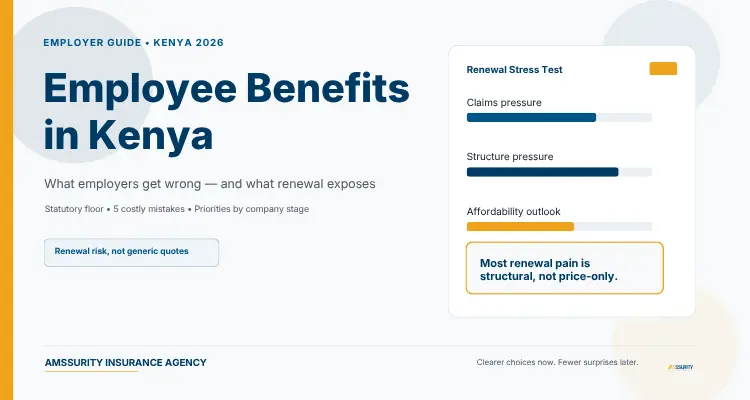
Most employers do not discover problems in their employee benefits structure when they buy it.
They discover them later.
At renewal. After claims rise. After HR starts fielding complaints. After finance asks why the benefits line moved faster than payroll. After someone realises the scheme looked reasonable on paper but was never built for the company’s actual stage, staff profile, or risk pattern.
That is the structural problem with employee benefits in Kenya. Not that employers do not care. Not that they refuse to spend. But that many companies approve a benefits structure once, renew it on autopilot, and never interrogate whether it still fits until renewal forces the question.
If you are a founder, HR lead, finance manager, or operations head responsible for a team, this matters more than it first appears. Employee benefits in Kenya are not one decision. They are a stack of decisions about compliance, retention, risk, cost control, staff experience, and renewal strategy.
Some are legal.
Some are commercial. Some are cultural. All of them become visible when the structure is under pressure.
This pillar guide is built for serious employers, who want a clear answer to five practical questions:
- What are the mandatory employee benefits in Kenya?
- What should a sensible benefits package look like beyond compliance?
- What makes employee benefits in Kenya become expensive over time?
- What should an employer benchmark before renewal?
- How do you build a structure that will still make sense 12 to 36 months from now?
The legal baseline is not guesswork. Salaried households pay SHIF/SHA contributions at 2.75% of gross salary or wage, subject to a minimum of KSh 300, with employer remittance obligations tied to the ninth day of each month.
Employees are entitled to at least 21 working days of annual leave, three months of maternity leave with full pay, two weeks of paternity leave with full pay, and sick leave after two consecutive months of service.
Employers must also obtain and maintain WIBA insurance, and the Employment Act requires housing or a sufficient housing allowance unless housing is already consolidated into pay.
NSSF has also moved into Year 4. NSSF published its Year 4 (2026) contribution notice on 18 February 2026, and the applicable 2026 limits are widely summarised by professional tax advisers as a KSh 9,000 lower earnings limit and KSh 108,000 upper earnings limit, producing a maximum combined monthly contribution of KSh 12,960 per employee.
That is the floor. It is not the strategy.
Table of Contents
What are employee benefits in Kenya?
At the broadest level, employee benefits in Kenya fall into two categories:
- Statutory employee benefits in Kenya: the rights, protections, deductions, and insurance obligations the law requires an employer to honour.
- Employer-sponsored employee benefits in Kenya: the benefits an employer adds above the legal minimum to improve attraction, retention, productivity, risk protection, and staff experience.
That distinction matters because many employers treat employee benefits in Kenya as one undifferentiated category. In practice, there are at least three separate decisions sitting inside every benefits package.
1. Compliance
What does the law require? What must be deducted, insured, provided, or documented? What happens if the employer gets it wrong?
2. Talent and retention
What does the company need to offer to attract and keep the right people for its stage, sector, and labour market?
3. Financial design
What is this structure likely to cost over the next one, two, and three renewals? Where is the pressure likely to come from? What part of the package is driving goodwill, and what part is quietly driving cost?
Most employers handle the first question passably. Some think seriously about the second. Very few interrogate the third with enough discipline.
That is why conversations about employee benefits in Kenya often go wrong. The company thinks it is buying a package. In reality, it is building a system.
The statutory floor: mandatory employee benefits in Kenya every employer should understand
Before you talk about competitive benefits, flexible packages, or retention strategy, the legal base has to be clean. Any serious approach to employee benefits in Kenya starts here.
Statutory baseline
What employers need to get right on statutory employee benefits and leave
Statutory compliance is the floor, not the full employee benefits strategy. The practical risk is not only missing the rule itself, but misunderstanding what the employer must actually operationalise in payroll, policy, and day-to-day administration.
| Statutory item | Current rule / minimum | What the employer must do | Common employer mistake |
|---|---|---|---|
| SHIF | 2.75% of gross salary or wage, minimum KSh 300 | Deduct and remit on time | Assuming SHIF removes the need for employer medical review |
| NSSF | Year 4 rates apply in 2026 | Update payroll, budgets, and contribution settings | Budgeting using old limits |
| WIBA | Mandatory insurance policy with approved insurer | Obtain and maintain valid cover | Confusing WIBA with GPA or general liability |
| Annual leave | At least 21 working days after 12 months | Track accrual, usage, and balances | Treating leave administration informally |
| Sick leave | 7 days full pay, then 7 days half pay after two months’ service | Apply policy and documentation consistently | Ignoring sick leave rules until a dispute arises |
| Maternity leave | 3 months with full pay | Maintain compliant leave process and return rights | Treating maternity solely as an HR issue, not a cost-planning issue |
| Paternity leave | 2 weeks with full pay | Build into leave policy and manager practice | Treating it as discretionary |
| Housing / house allowance | Employer must provide housing or sufficient housing allowance unless consolidated | Ensure employment contracts and payroll reflect this clearly | Assuming salary automatically covers it without proper consolidation language |
The legal anchors above are grounded in the Social Health Insurance Regulations, the Employment Act, and the Work Injury Benefits Act.
What this means in practice
The biggest mistake employers make with the statutory side of employee benefits in Kenya is assuming it is a low-value checklist. It is not. It is the base layer of trust and risk management.
A benefits structure can look generous on paper and still be weak if the compliance layer is poorly managed. Common examples include:
- Payroll teams still running outdated NSSF assumptions;
- Employers who talk about “medical cover” without clean WIBA placement;
- Offer letters that reference house allowance vaguely;
- Businesses that record leave inconsistently and only discover gaps during employee exits or disputes.
If the statutory layer is messy, the rest of the package sits on a weak foundation.
Most renewal pressure starts earlier than employers think.
Before you redesign the package, test the basics first. The Employee Benefits Renewal Checklist helps you check whether your statutory obligations, payroll setup, contracts, and early renewal signals are fully aligned before the pressure shows up in the insurer’s number.
- Compliance check: whether SHIF, NSSF, WIBA, leave, and housing obligations are aligned with current policy and payroll
- Consistency check: whether your contracts, payroll records, and actual practice are saying the same thing
- Early warning check: whether renewal risk is building before the underwriter prices it back to you
Best next step: run a quick internal review now, while you still have time to fix what matters, not after the renewal letter arrives.
The strategic layer: employer-sponsored employee benefits in Kenya beyond compliance
Once the statutory floor is clean, the question becomes what to build above it. This is where employee benefits in Kenya stop being a legal conversation and become a business-design conversation.
Common employer-sponsored employee benefits in Kenya
Benefits architecture
What each employee benefit usually does — and where employers go wrong
Not every benefit solves the same problem. The mistake is treating employee benefits as one bundle instead of understanding what each one is for, who usually needs it, and where poor structuring creates avoidable gaps.
| Benefit | What it usually covers | Who most often needs it | Common structuring mistake |
|---|---|---|---|
| Corporate medical insurance | Inpatient, outpatient, maternity, sometimes dental/optical/chronic support | Most formal employers with growth, retention, or duty-of-care needs | Comparing only premium and headline limit |
| Group life insurance | Death benefit, often salary multiple | Employers wanting baseline family protection for staff | Setting a multiple once and never reviewing it |
| Group personal accident (GPA) | Accidental death, disability, temporary total disability | Employers with field staff, drivers, site teams, mobile staff | Using GPA as a substitute for WIBA |
| Occupational pension | Retirement savings above NSSF | Growth-stage SMEs, professional firms, employers seeking retention depth | Launching it without contribution clarity or communication |
| Last expense / funeral cover | Lump sum on death of employee or dependants | Employers with broad-based workforces or stronger welfare positioning | Treating it as a symbolic add-on without fit |
| Dental and optical | Routine dental care, glasses, eye checks | Professional workforces, staff groups where utilisation and goodwill matter | Adding low-value riders without checking usage and provider access |
| Wellness / EAP / counselling | Mental health support, screening, wellbeing programs | Higher-stress, professional, or people-intensive workplaces | Buying “wellness” because it sounds progressive without staff fit |
The anchor product in most discussions about employee benefits in Kenya is corporate medical insurance. And that makes sense. It is usually the most emotionally visible benefit, the most politically sensitive during renewal, and often the biggest cost line.
But it is also the product employers misread most often.
Why corporate medical drives so much of the conversation
When employers discuss employee benefits in Kenya, they often speak as if medical insurance is a single decision: choose an insurer, choose a premium, choose a hospital list, move on.
In practice, a corporate medical scheme contains a series of smaller decisions:
- Inpatient limit;
- Outpatient design;
- Provider network quality;
- Maternity waiting periods and sublimits;
- Chronic condition treatment;
- Dental and optical structure;
- Co-payments, deductible and excess structure
- Pre-existing condition terms;
- How much freedom staff have to utilise outpatient services without friction.
Get those decisions right and the scheme can hold up reasonably well. Get them wrong and renewal becomes a recurring negotiation about damage, not design.
Group life and Group personal accident: often undervalued, often misunderstood
Not every employer needs the same emphasis. Some businesses are overly fixated on medical and underbuild the rest of the structure.
Group life is often one of the most cost-efficient parts of employee benefits in Kenya because it gives families real protection without carrying the same utilisation pattern as medical insurance.
Group personal accident cover (GPA) matters most where staff are mobile, field-based, exposed to accidents, or working in higher-risk environments. But it is a complement to WIBA, not a substitute. WIBA deals with work injury liability. GPA is a broader accidental-benefit product. Conflating the two is one of the most common design errors employers make.
Pension: less visible, but more strategic than many employers assume
For many SMEs, pension feels like something to consider “later.” That instinct is understandable, but often short-sighted.
In employee benefits in Kenya, pension tends to have a different effect from medical. Medical is emotionally immediate. Pension is slower, quieter, and more identity-based. It tells staff the company expects to be around, intends to behave seriously, and is willing to think beyond the next 12 months.
That does not mean every 12-person business should start with a sophisticated retirement structure. It means employers should stop treating pension as something only large corporates can think about.
How to structure employee benefits in Kenya by company stage
One of the easiest ways to make employee benefits in Kenya expensive is to copy another company’s structure without asking whether it matches your stage.
A 15-person professional services firm should not structure benefits the same way as a 120-person manufacturer. A logistics business with mobile field teams will not have the same benefit logic as a Nairobi office-based consulting firm. A company with a young workforce planning families will not carry the same medical dynamics as one with an older leadership-heavy team.
A practical employee benefits in Kenya matrix by company stage
Company-stage planning
How employee benefits should change as a company grows
The right benefits structure depends on company stage. Early on, the focus is clean compliance and cost control. As headcount rises, renewal discipline, governance, and scheme design start to matter much more.
| Company stage | Main priority | Sensible baseline | What to avoid |
|---|---|---|---|
| Under 10 staff | Clean compliance and manageable cost | SHIF, NSSF, WIBA, leave compliance, simple medical if budget allows | Overbuilding a package the business cannot sustain |
| 10–25 staff | Basic retention and credibility | Compliance + carefully structured medical + GPA where relevant | Choosing benefits to “look like a big company” |
| 25–50 staff | Renewal discipline starts to matter | Compliance + medical + life + GPA + possibly dental/optical | Running medical with no utilisation review |
| 50–100 staff | Insurance becomes a management system | Formal renewal process, data review, life, GPA, stronger medical governance, pension discussion | Treating benefits as a procurement event |
| 100–200 staff | Governance, benchmarking, and committee logic | Claims analytics, structured policy review, staged communication, pension or broader welfare framework | Renewing by habit and reacting late |
Under 10 staff: keep it clean
At this stage, employee benefits in Kenya should focus on:
- Statutory compliance;
- Administrative simplicity;
- Cost sustainability;
- Avoiding an emotionally attractive but financially unstable structure.
The failure mode here is overreach. A founder wants to look competitive, approves a polished benefits package, and six to twelve months later realises the business cannot comfortably absorb it.
10 to 50 staff: this is where strategy starts
This is the range where employee benefits in Kenya become genuinely strategic.
At this stage, the employer is no longer simply trying to “offer something.” It is starting to make choices that shape:
- Hiring quality;
- Employee perception;
- Claims experience;
- Renewal trajectory;
- Internal fairness debates.
This is also where mistakes become expensive enough to matter but not yet visible enough to trigger real governance. That is why so many SMEs drift into bad structures here.
50 to 200 staff: this is now a management system
Above roughly 50 staff, employee benefits in Kenya move out of the category of “HR admin” and into “business system.”
Why?
Because now the package affects:
- Budget predictability;
- Staff experience at scale;
- Underwriter perception;
- Finance planning;
- Leadership credibility;
- The company’s ability to negotiate from a position of data instead of emotion.
At this stage, employers need more than a quote comparison. They need structure, review discipline, and clarity on what is driving cost.
The real cost of employee benefits in Kenya
One reason employers misread employee benefits in Kenya is that they confuse premium with cost.
Premium is only one part of the picture.
The true cost includes:
- Insurer premium;
- Staff top-up expectations, where relevant;
- HR and finance admin time;
- Claims support time;
- Lost goodwill when staff experience friction;
- Renewal increases driven by poor design or poor utilisation management;
- The cost of switching insurers without solving the real problem.
That is why the cheapest quote is often the wrong question.
The cost stack employers should actually analyse
When assessing employee benefits in Kenya, employers should separate costs into five buckets:
1. Statutory cost
SHIF, NSSF, WIBA, leave obligations, housing/house allowance implications.
2. Insurance spend
Medical, group life, GPA, pension contributions, dental/optical, last expense.
3. Administrative cost
How many hours HR, payroll, and finance spend managing queries, onboarding, claims friction, reconciliations, and renewal firefighting.
4. Behavioural cost
What happens when the structure teaches staff to overuse some parts of the scheme and under-value others?
5. Renewal cost
What today’s design is likely to do to next year’s renewal.
This is the part most employers neglect.
Cost pressure is not imaginary
Local and regional indicators both show ongoing health-cost pressure. KNBS Consumer Price Index reported in January 2026 that medical insurance prices rose 1.0% month-on-month from December 2025, and the Health division recorded 0.3% inflation in March 2026. Separately, WTW’s 2026 Global Medical Trends Survey projects 11.3% medical trend for the Middle East and Africa region in 2026, up from 10.3% in 2025.
That does not mean every employer in Kenya will face the same renewal increase. It does mean the operating environment is not forgiving. If a scheme is badly designed, external pressure amplifies internal weakness.
The hidden cost drivers inside medical schemes
For most employers, the most volatile part of employee benefits in Kenya is medical insurance. The main pressure points are usually not mysterious:
- Unrestricted outpatient utilisation;
- Poor fit between workforce profile and maternity design;
- Weak chronic-condition management;
- Hospital network misfit;
- Late renewal engagement;
- Switching insurers without changing benefit design or staff behaviour.
The companies that manage this well are not necessarily the ones spending the least. They are the ones asking better questions earlier.
The 5 costly mistakes employers make with employee benefits in Kenya
This is where most of the damage happens.
Mistake 1: Comparing premiums instead of exposure
A lower premium is not automatically a lower cost structure.
In employee benefits in Kenya, premium is what you pay today. Exposure is what the structure is likely to cost you over time.
An employer that compares only premium misses the real drivers:
- Claims pattern;
- Outpatient visit frequency;
- Maternity profile;
- Chronic-condition concentration;
- Network usage;
- Workforce age mix.
That is how businesses “save money” at placement and then get punished at renewal.
Mistake 2: Changing insurers without changing behaviour
This is one of the most common traps in employee benefits in Kenya.
An employer has a bad claims year. Renewal comes in high. The company moves insurers. Premium drops in Year 1. Everyone feels relieved.
Then, by the next cycle, the same utilisation pattern reappears. The same claims dynamics reappear. The same renewal pressure returns under a different logo.
Switching insurer can be the right move. But when it is used as a substitute for diagnosis, it is usually just a delay tactic.
Mistake 3: Treating medical insurance as a perk, not a system
Once a business grows past a certain size, medical cover is not just a “nice thing for staff.”
It affects:
- Staff trust;
- Management credibility;
- Cashflow planning;
- HR bandwidth;
- Leadership attention;
- Recruitment positioning.
At that point, employee benefits in Kenya are no longer a side decision. They are part of operating design.
Mistake 4: Copying another employer’s structure blindly
This is where ego enters the room.
A founder hears what a larger company offers and wants to match it. An SME copies a multinational’s structure because it sounds competitive. A business owner borrows a package from a peer in another sector with a completely different risk profile.
But employee benefits in Kenya should be designed for:
- Your staff profile;
- Your margins;
- Your admin capacity;
- Your retention risk;
- Your sector exposure;
- Your renewal tolerance.
What looks impressive in a job ad can become structurally awkward in practice.
Mistake 5: Running benefits on a 12-month horizon – The 5 Whats
This is perhaps the deepest strategic mistake.
Many employers review employee benefits in Kenya one year at a time. Serious operators look at:
- What happens if headcount grows faster than revenue;
- What happens if claims stay elevated;
- What happens if maternity usage rises;
- What happens if the staff mix shifts;
- What happens if medical trend stays high for two or three cycles.
A benefits structure is not just for this renewal. It is a system that either gets more coherent over time or more fragile.
If those five mistakes sound familiar, another quote is probably too early.
A better next step is a Benefit Scheme Audit. We review your current package to show what you have, what it is costing you, where duplication, gaps, or renewal pressure are building, and what trade-offs you are actually choosing before you switch, cut, or expand benefits.
- What you have: a clear view of your current structure
- What it is costing you: where spend is justified and where it may be leaking
- Where pressure is building: duplication, gaps, and likely renewal strain
- Fit test: whether the scheme still matches your workforce and current stage
- Decision clarity: the trade-offs you are actually choosing before you make changes
No obligation. No generic presentation. Just a clearer view of whether your current structure will still make sense at renewal and at claim time.
What employers should benchmark before renewal
If you want to manage employee benefits in Kenya properly, renewal should not start when the insurer emails the renewal terms.
It should start 90 to 120 days earlier.
The question is not just, “Is this quote high?”
The real question is, “What is this quote reacting to, and what should we have seen coming?”
A practical renewal benchmark for employee benefits in Kenya
Renewal diagnostics
What to review before you renew an employee medical scheme
A good scheme review should not stop at premium. It should test claims pressure, utilisation patterns, provider fit, and where the next renewal problem is likely to come from.
| Benchmark | What to ask | Why it matters | Early warning signal |
|---|---|---|---|
| Claims loss ratio | What percentage of total premium was paid back as claims over the last 12 months? | Shows whether the scheme is under pricing pressure and how exposed you are at renewal. | Loss ratio stays high over multiple periods or rises without a clear one-off driver. |
| Outpatient utilisation pattern | How many visits per member were recorded, and what was the average cost per visit? | Helps identify overuse, weak controls, or poor provider discipline before costs escalate. | Visit frequency rises faster than headcount or average cost per visit keeps climbing. |
| Maternity claims exposure | What share of total claims spend came from maternity, and is that trend changing? | Maternity is a predictable cost driver in some workforce profiles and should be designed for intentionally. | Maternity claims become a growing share of total spend without any benefit redesign. |
| Chronic-condition concentration | How much of total claims cost is tied to chronic care, and how concentrated is it across members? | Shows long-tail cost pressure and whether a small member group is shaping overall scheme performance. | A small member group accounts for a disproportionately large share of annual claims. |
| Provider network fit | Are employees actually using the intended hospitals, clinics, and specialists? | A misaligned network creates friction, poor experience, and unexpected claims behaviour. | Frequent out-of-network use, repeated staff complaints, or persistent hospital access issues. |
| Benefit-to-usage alignment | Which benefits are used heavily, which are rarely used, and what do employees actually value? | Prevents paying for benefit features that look good on paper but add little practical value. | Low-use benefits continue to inflate cost while high-value benefits remain constrained. |
| Contribution balance | Are the employer and employee contribution levels still sustainable and perceived as fair? | Contribution design affects retention, affordability, and long-term scheme stability. | Budget strain increases, opt-outs rise, or staff dissatisfaction becomes more visible. |
| Insurer service responsiveness | How quickly and effectively are claims, pre-authorisations, escalations, and member queries being handled? | Scheme experience matters as much as premium because poor service pushes HR into an informal claims desk role. | Repeated complaints, delayed approvals, unresolved queries, or HR spending too much time chasing the insurer. |
A practical benchmark mindset
The point of benchmarking employee benefits in Kenya is not to squeeze every part of the package. It is to understand which parts are:
- Legally required;
- Strategically important;
- Emotionally important;
- Structurally expensive;
- Underused;
- Badly designed.
That lets you separate the three “Whats” that most employers often blur together:
- What staff value,
- What the business can sustain,
- What the current insurer is reacting to.
Those are not the same thing.
What a sensible employee benefits package in Kenya looks like for an SME
There is no perfect universal package. But there is such a thing as a sensible one.
A practical SME package example for employee benefits in Kenya
Illustrative employer profiles
How the right employee benefits package changes by employer profile
The right structure depends on workforce shape, operating risk, and cost tolerance. A sensible package is not the biggest package. It is the one that fits the employer’s reality and is reviewed before weak design turns into a renewal problem.
| Employer profile | Baseline package | Why it makes sense | What to review annually |
|---|---|---|---|
| 12-person professional services firm | Compliance + basic medical + WIBA + life | Establishes credibility without overbuilding | Outpatient usage, maternity fit, affordability |
| 25-person logistics company | Compliance + medical + WIBA + GPA + life | Better fit for mobile field risk | Accident exposure, GPA adequacy, network access |
| 40-person consulting/tech firm | Compliance + stronger medical + life + dental/optical | White-collar goodwill and retention | Outpatient control, mental-health support, cost trend |
| 75-person mixed workforce SME | Compliance + medical + WIBA + GPA + life + possible last expense | Broader staff profile often needs wider protection logic | Claims mix, fairness, communication quality |
| 120-person growth-stage employer | Full governance-led approach incl. pension discussion | Benefits now affect the P&L and culture materially | Claims analytics, design fit, insurer service quality |
What “sensible” actually means
A sensible structure for employee benefits in Kenya is not the one with the most features.
It is the one that:
- Meets legal requirements cleanly;
- Matches the workforce profile;
- Respects the company’s stage and budget;
- Is understandable to staff;
- Will still make sense at next renewal.
That last point is where many packages fail.
Frequently asked questions about employee benefits in Kenya
Employee benefits in Kenya: the questions employers ask most
A plain-English FAQ for employers, HR teams, and business owners who want cleaner compliance, better benefit design, and fewer expensive surprises at renewal or claim time.
1. What are employee benefits in Kenya?
They include both statutory obligations and employer-sponsored benefits. Statutory items include SHIF, NSSF, WIBA, leave rights, sick leave, maternity and paternity leave, and housing or housing allowance obligations. Employer-sponsored benefits commonly include medical insurance, group life, GPA, pension, and wellness-related benefits.
2. What are the mandatory employee benefits in Kenya?
At a minimum, employers need to pay attention to SHIF, NSSF, WIBA, annual leave, sick leave, maternity leave, paternity leave, and housing or house allowance requirements. The exact operational duty varies by item, but these are core parts of the statutory floor.
3. Does SHIF replace employer medical insurance?
Not necessarily. SHIF is part of the statutory health financing framework. Many employers still use corporate medical insurance because SHIF and employer medical serve different roles in practice. The mistake is assuming SHIF alone answers the broader design question.
4. Is WIBA the same as group personal accident cover?
No. WIBA is a statutory employer liability requirement for work injury. GPA is a separate accident-benefit product. They can complement each other, but they are not interchangeable.
5. What is the biggest cost driver in employee benefits in Kenya?
For many formal employers, it is medical insurance, particularly where outpatient design, maternity exposure, network fit, and renewal management are weak. But the biggest structural mistake is usually poor design, not merely high pricing.
6. How often should a company review employee benefits in Kenya?
At minimum, annually. In practice, employers should review benefits before renewal, after major staff-profile changes, after rapid headcount growth, after major claims shifts, or when moving into a new operating stage.
7. What should an SME offer first when it comes to employee benefits in Kenya?
Start with clean compliance. Then add benefits that solve the most relevant problem for the company’s stage. For many SMEs, that means carefully designed medical cover, WIBA, and basic life or accident protection before chasing cosmetic add-ons.
8. Should employers benchmark employee benefits before renewal?
Yes. Without benchmarking loss ratio, utilisation, maternity exposure, chronic claims mix, and insurer responsiveness, the employer is negotiating blind.
9. Are employee benefits in Kenya mainly an HR issue?
No. They sit at the intersection of HR, finance, leadership, and risk management. Once a company grows beyond a very small size, the package becomes a management system, not just an HR benefit list.
10. What is the best way to improve employee benefits in Kenya without losing cost control?
Do not start by adding more. Start by clarifying what you already have, what staff actually use, what drives renewal pressure, and where the structure does not match your workforce.
Final thought
The real challenge with employee benefits in Kenya is not deciding whether benefits matter. Most serious employers already know they do.
The real challenge is deciding whether your current structure is:
- Legally clean,
- Commercially sensible,
- Emotionally credible,
- And sustainable under pressure.
Many employers handle the compliance layer adequately. Some think carefully about the talent layer. Far fewer give enough attention to the financial design layer until renewal forces the issue.
That is why benefits often look fine until they suddenly feel expensive, politically difficult, or operationally weak.
A better question than “what is the cheapest quote?” is this:
What kind of employee benefits system are we actually building, and will it still hold up when claims rise, staff expectations sharpen, and renewal stops being forgiving?
That is the question serious employers should ask about employee benefits in Kenya.
A good benefits structure does not just look competitive when it is sold.
It still makes sense when it is tested.
Renewal pressure is easier to fix before the letter arrives.
A Benefit Scheme Audit helps you see what your current structure is doing, what it is costing you, where duplication or renewal pressure is building, and what trade-offs you are actually choosing before you switch insurers, cut benefits, or approve a more expensive renewal.
- What you have: a clear view of your current benefit structure
- What it is costing you: where spend is justified and where it may be leaking
- Where pressure is building: duplication, gaps, and likely renewal strain
- Fit test: whether the scheme still matches your workforce and business stage
- Decision clarity: the real trade-offs before you make a rushed change
No obligation. No generic presentation. Just a clearer view of whether your current structure will still make sense at renewal and at claim time.

Founder & Insurance Advisor | Amssurity Insurance Agency, an IRA-licensed agency in Nairobi
Agnes Mukulu advises individuals, families, SMEs and diaspora Kenyans on health, motor, business, life and international medical insurance. Having reviewed hundreds of policies, quotations and benefit schedules, she helps clients look beyond premiums to understand benefits, exclusions, waiting periods, excesses and claims requirements. She founded Amssurity to make insurance guidance clearer, more transparent and more practical, helping clients choose suitable cover and understand how it should work when they need it most.