

How Much Is Car Insurance in Kenya? Rates, Levies and Worked Examples in 2026
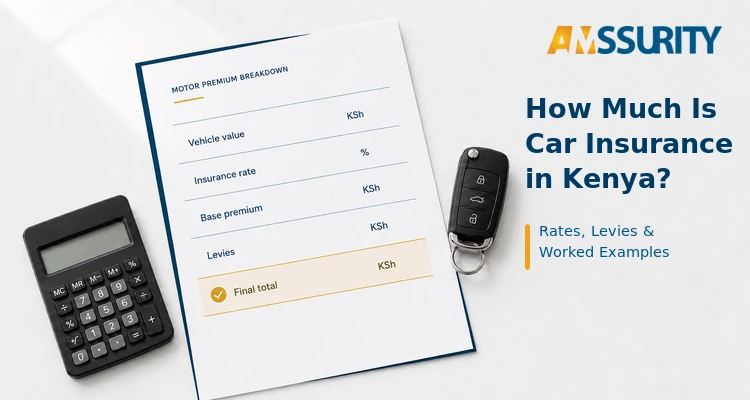
A 4% car insurance rate is not the amount you finally pay.
Minimum premiums, levies, stamp duty and optional benefits can push the invoice higher. A cheaper quotation can also leave you with a larger excess or fewer useful benefits when you claim.
How much is car insurance in Kenya? Private Third Party Only commonly starts from a KSh 7,500 base premium, which becomes approximately KSh 7,574 after the usual percentage-based charges and KSh 40 stamp duty.
Comprehensive car insurance is normally calculated as a percentage of the vehicle’s insured value. Private-car rates can fall broadly between 3% and 7.5%, subject to the insurer’s minimum premium and underwriting rules.
For example, a car valued at KSh 1,000,000 and rated at 5% produces a base premium of KSh 50,000 and an illustrative total of KSh 50,265 before paid extras or valuation costs.
Table of Contents
How much is car insurance in Kenya in 2026?
The answer to how much is car insurance in Kenya depends on the type of cover, vehicle value, insurer rate, minimum premium, actual use and optional benefits selected.
| Cover or use | Pricing guide | Key point |
|---|---|---|
| Private TPO | About KSh 7,574 total | Your car is not covered |
| Fire & Theft | Rate on vehicle value, subject to a minimum premium | Excludes accidental damage to your car |
| Private Comprehensive | About 3% to 7.5%, subject to a minimum premium | Levies and paid benefits are added |
| Ride-hailing, PSV or commercial | Priced by vehicle class, use, capacity or tonnage | Private-car rates do not apply |
Kenyan law requires a qualifying policy or security against third-party risks before a vehicle is used on a road. Comprehensive insurance remains a commercial choice unless a financier or another contract requires it.
See our guide to the types of car insurance in Kenya for the differences between TPO, TPFT and comprehensive cover.
How is car insurance calculated in Kenya?
For comprehensive private motor insurance, the starting calculation is:
Base premium = insured vehicle value × insurer rate
The insurer may then apply a minimum premium. Where the percentage calculation falls below that minimum, the minimum becomes the base premium.
The simplified calculation is:
Total payable = base premium + paid optional benefits + percentage-based charges + KSh 40 stamp duty
Your quotation should show the base premium, optional benefits, levies and final amount separately. That breakdown is more useful than receiving a percentage on its own.
Worked car insurance cost examples
These examples explain the calculation method. They are illustrations rather than binding quotations.
They exclude paid optional benefits, valuation fees and any special underwriting terms.
Example 1: Private Third Party Only
Assume the insurer quotes a KSh 7,500 base premium.
| Calculation | Amount |
|---|---|
| Base premium | KSh 7,500.00 |
| Training levy at 0.2% | KSh 15.00 |
| Policyholders Compensation Fund contribution at 0.25% | KSh 18.75 |
| Stamp duty | KSh 40.00 |
| Illustrative total | KSh 7,573.75 |
The invoice may round this to KSh 7,574.
Example 2: KSh 1 million car at a 5% comprehensive rate
| Calculation | Amount |
|---|---|
| Vehicle value × rate | KSh 1,000,000 × 5% |
| Base premium | KSh 50,000.00 |
| Training levy at 0.2% | KSh 100.00 |
| Policyholders Compensation Fund contribution at 0.25% | KSh 125.00 |
| Stamp duty | KSh 40.00 |
| Illustrative total | KSh 50,265.00 |
The owner would pay approximately KSh 50,265 before optional benefits or valuation.
Example 3: KSh 3 million car at a 3.25% comprehensive rate
A KSh 3,000,000 car rated at 3.25% produces a KSh 97,500 base premium.
After the two percentage-based charges and KSh 40 stamp duty, the illustrative total becomes KSh 97,978.75.
This example shows why the rate alone can be misleading. A higher-value vehicle may receive a lower percentage rate while producing a larger shilling premium.
Want the actual number for your vehicle?
Get three matched options with premiums, excesses and key benefits compared on one page.
Why comprehensive car insurance rates differ
The 3% to 7.5% range is a budgeting guide rather than a fixed market tariff. Insurers apply their own acceptance and pricing rules.
| Rating factor | How it can affect your quotation |
|---|---|
| Insured value | Sets the starting point for percentage-based pricing and potential settlement. |
| Vehicle age | Older vehicles may attract higher rates, different excesses or restricted terms. |
| Make and model | High-theft, expensive or difficult-to-repair models may cost more to insure. |
| Actual use | Private, ride-hailing, PSV and commercial vehicles require the correct class of cover. |
| Claims history | Previous claims can affect the premium or acceptance terms. |
| Driver profile | Experience and named-driver requirements can affect the rate or excess. |
| Minimum premium | The insurer’s minimum applies when the percentage calculation produces a lower amount. |
A current valuation helps establish a realistic insured value. Accurate vehicle use is equally important because a private-use quotation is unsuitable for a vehicle used for ride-hailing, passenger transport or deliveries.
How minimum premiums affect the price
When estimating how much is car insurance in Kenya for a lower-value vehicle, the insurer’s minimum premium may matter more than the advertised percentage rate.
Suppose a car is valued at KSh 500,000 and the quoted comprehensive rate is 4%.
The percentage calculation produces:
KSh 500,000 × 4% = KSh 20,000
If the insurer has a minimum comprehensive premium of KSh 37,500, the KSh 37,500 minimum becomes the base premium.
The owner would then pay the minimum premium, applicable levies, stamp duty and any selected benefits.
This is why lower-value vehicles can attract a higher insurance cost relative to their value. In some cases, TPFT or TPO may be more financially practical.
If you are choosing between lower-cost cover and broader protection, compare comprehensive and third-party car insurance in Kenya before deciding on price alone.
Which benefits can increase the final premium?
Comprehensive policies may include certain benefits up to stated limits. Higher limits and additional benefits can increase the final amount.
| Optional benefit | How it can affect the price | What to confirm |
|---|---|---|
| Excess protector | May be included or charged as a percentage subject to a minimum | Which excesses it protects and which remain payable |
| Political violence and terrorism | May be included for some vehicles or charged separately | Events covered, excess and territorial terms |
| Courtesy car or loss of use | Can add a fixed premium | Waiting period, daily limit and number of days |
| Breakdown road rescue | May cost extra beyond accident towing | Radius, incident limits and exclusions |
| Higher windscreen or entertainment limits | Adds premium above the free limit | Insured value, excess and reinstatement after a claim |
Accident towing and mechanical-breakdown rescue are different benefits. A policy may include towing after an insured accident while requiring separate road-rescue cover for a battery failure, puncture or mechanical breakdown.
Our guide to motor insurance upgrades in Kenya explains these options in more detail.
The lowest premium may leave you with a higher claim-time cost
The annual premium should be considered together with the costs and conditions that apply after an accident, theft or other insured event.
| Compare | Why it matters |
|---|---|
| Final payable premium | Confirms the amount after levies, stamp duty and selected benefits |
| Standard and special excesses | Shows what you may have to fund when making a claim |
| Insured value | Affects both the premium and potential settlement |
| Windscreen, entertainment and towing limits | Shows whether the included limits suit your vehicle |
| Repair and settlement terms | Affects where and how an admissible claim may be repaired or settled |
| Instalment terms | Shows the amount required before cover starts and when later payments fall due |
A quotation that saves KSh 5,000 on the annual premium may carry a larger excess, lower free limits or fewer optional benefits. Compare the total structure before deciding.
Those differences matter most after an incident. Our car insurance claims guide for Kenya explains the reporting, assessment, repair and settlement process.
Our best car insurance companies in Kenya guide explains how to compare insurer fit beyond the rate.
Can car insurance be paid in instalments?
Some insurers allow annual comprehensive premiums to be paid in instalments.
The payment arrangement may require a substantial first instalment before cover begins, followed by scheduled payments during the policy period. The exact percentages, due dates and eligibility rules vary.
Before accepting an instalment arrangement, confirm:
- The amount required before cover starts.
- The dates of the remaining instalments.
- What happens if an instalment is late.
- Whether the full outstanding premium becomes payable after a claim.
- Whether the payment arrangement adds any fees or conditions.
An instalment plan changes when you pay. It does not reduce the annual premium.
What information is needed for an accurate quotation?
Prepare the vehicle registration number, year of manufacture, make and model, estimated current value, actual use, ownership or financing details and recent claims history.
Comprehensive cover may also require vehicle photographs, inspection or a professional valuation.
Accurate information produces a more reliable price. It also reduces the likelihood of disputes about vehicle value, ownership or use.
If you are ready to proceed, see how to buy car insurance in Kenya online and what to confirm before paying.
So, how much is car insurance in Kenya for your vehicle?
For a private car, use approximately KSh 7,574 as a practical starting point for annual TPO.
For comprehensive cover, multiply the vehicle’s current value by an indicative rate between 3% and 7.5%. Test the result against the insurer’s minimum premium, then add the applicable charges and any selected benefits.
That calculation gives you a useful budget. Your final decision should use a vehicle-specific quotation showing:
- The total payable premium.
- Standard and special excesses.
- Included windscreen, entertainment and towing limits.
- Paid optional benefits.
- Repair and settlement terms.
- Instalment requirements.
Compare three matched motor quotes.
See the total price, excess and key benefits side by side.
The indicative comprehensive range also reflects private-motor quotations reviewed by Amssurity Insurance Agency in July 2026.
Insurance prices and underwriting rules can change. The worked examples are provided for education and budgeting. They do not constitute a quotation or policy offer. Cover remains subject to the insurer’s acceptance, policy schedule, wording, limits, excesses and exclusions.

Founder & Insurance Advisor | Amssurity Insurance Agency, an IRA-licensed agency in Nairobi
Agnes Mukulu advises individuals, families, SMEs and diaspora Kenyans on health, motor, business, life and international medical insurance. Having reviewed hundreds of policies, quotations and benefit schedules, she helps clients look beyond premiums to understand benefits, exclusions, waiting periods, excesses and claims requirements. She founded Amssurity to make insurance guidance clearer, more transparent and more practical, helping clients choose suitable cover and understand how it should work when they need it most.