

Maternity Insurance in Kenya: Timing, Limits and Gaps
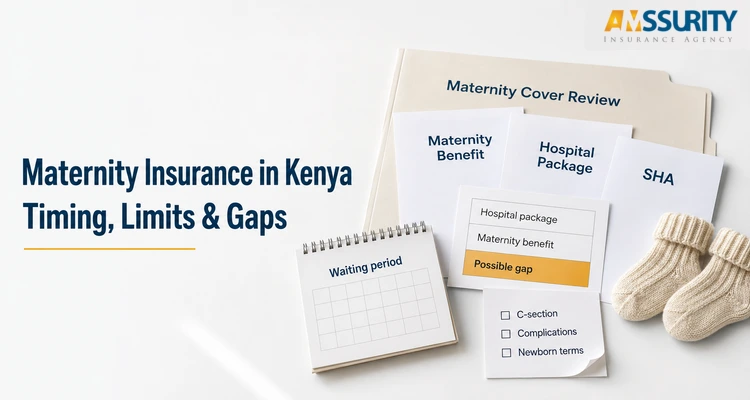
You can buy maternity insurance in Kenya and still pay a large part of the delivery bill yourself.
The gap appears when the waiting period, maternity limit, hospital package, doctor fees, C-section terms and newborn costs do not line up. SHA may contribute, but it does not automatically remove every private-hospital cost.
For most families, maternity is a benefit within wider medical insurance, not a last-minute policy bought after pregnancy begins. Test it against the hospital you would use and what happens if delivery does not go as planned.
Table of Contents
How maternity insurance in Kenya works
Maternity cover may sit within individual, family or employer medical insurance. It normally has its own limit and conditions, separate from the main inpatient limit.
For example, a policy may show an inpatient limit of KSh 3 million but restrict maternity claims to KSh 100,000. The maternity limit, not the KSh 3 million headline, is the starting point when estimating what the insurer may pay for delivery.
Depending on the plan, it may contribute towards antenatal care, normal delivery, C-section, professional fees and postnatal care. Every item remains subject to the schedule, waiting period, exclusions and approvals.
The practical question is: How will this maternity benefit work at my preferred hospital when I need it?
The maternity waiting period is the first test
A waiting period is the time between the policy start date and when a benefit can be used. AAR’s published guidance gives a general maternity range of 10–12 months, but the actual period and wording differ by product.
Do not check only the number of months. Ask whether the restriction applies to pregnancy-related consultations, conception, the delivery claim or every maternity expense incurred during that period.
Employer schemes can work differently. Some have reduced or waived waiting periods, but this should never be assumed. Ask whether the restriction applies to new employees, newly added spouses and members joining during the policy year.
If pregnancy is planned within 12–18 months, compare now. Once pregnancy is confirmed, a new private maternity benefit will usually be too late for that pregnancy.
Can you buy maternity insurance when already pregnant?
You may be able to buy medical insurance while pregnant, subject to underwriting, but a new policy will usually exclude the existing pregnancy and delivery. It may cover other eligible health risks, but it should not be presented as the solution for the current delivery.
If you are already pregnant, first check:
- Whether an existing individual, family or employer policy already includes maternity.
- Whether the benefit is active and what limit applies.
- Your SHA status and the arrangement at your preferred hospital.
- The hospital’s normal-delivery and C-section packages.
- What the packages exclude and what cash buffer may still be needed.
This is a delivery-funding review, not a search for a policy that promises to cover a known pregnancy after the fact.
SHA, private maternity insurance cover and hospital packages are different
The maternity bill can involve three separate arrangements. They should not be treated as interchangeable.
| Arrangement | What it may contribute | What still needs confirmation |
|---|---|---|
| SHA | Eligible maternity and newborn services through the applicable benefit and facility arrangement | Current tariff, member eligibility, facility level, authorisation and whether the hospital quote is already net of SHA |
| Private medical insurance | Eligible expenses up to the active maternity limit | Waiting period, hospital panel, C-section terms, exclusions, approvals and coordination with SHA |
| Hospital maternity package | A stated package for normal delivery or C-section | External doctors, complications, room upgrades, additional tests, longer admission and newborn treatment |
At the time of review, the published SHIF tariff document lists KSh 11,200 for normal delivery and KSh 32,600 for C-section, including essential newborn care, at Levels 4–6. In June 2026, the Ministry of Health separately announced proposed reimbursement of KSh 10,000 and KSh 30,000 under an expanded package.
Because the framework is changing, do not treat a national tariff as cash automatically deducted from every private-hospital bill. Ask the hospital what SHA amount applies and whether its quotation has already accounted for it.
6 Costly Maternity Cover Gaps to Avoid
“Maternity included” can sound reassuring while leaving important costs unpaid. Before choosing a plan, test these six possible gaps in the benefit schedule and policy wording.
| Costly gap | Question to ask before paying |
|---|---|
| 1. Waiting period | How long must I wait, and which pregnancy-related costs remain excluded during that period? |
| 2. Maternity limit | What is the maximum payable, and is there a different amount for normal delivery and C-section? |
| 3. Preferred hospital | Is the hospital on the insurer’s panel, and can the maternity benefit be used there without reimbursement? |
| 4. Delivery and complications | Are professional fees, emergency C-section, assisted delivery, pregnancy complications and longer admission included? |
| 5. Newborn terms | When can the baby be added, and how are newborn illness, congenital conditions and neonatal ICU treated? |
| 6. Approvals and payment | What needs pre-authorisation, what deposit may be required, and how does the insurer coordinate with SHA? |
The benefit schedule matters more than the brochure. Compare health insurance options online to test these six gaps before you buy.
How much maternity cover do you need?
Start with the hospital, not the insurer.
Ask for the current normal-delivery and C-section packages, what they exclude and whether SHA has already been reflected in the quotation.
The range can be wide even within one hospital. Nairobi West Hospital currently publishes normal-delivery packages from KSh 62,000 to KSh 130,000 and C-section packages from KSh 182,000 to KSh 318,000. These are not market averages, but they show why a maternity limit cannot be assessed alone.
Consider this illustrative case:
A couple prefers a hospital with a C-section package of KSh 180,000. Their active maternity benefit is KSh 100,000. The starting gap is KSh 80,000 before non-package fees, complications, longer admission or separate newborn treatment. They must also confirm whether the quotation is already net of SHA.
Use this calculation:
Expected hospital, doctor and newborn costs − confirmed SHA and insurer payments = possible out-of-pocket exposure
Use only confirmed amounts. Do not subtract SHA and private insurance twice or assume both will reimburse independently.
Newborn cover is not a footnote
The mother’s delivery bill and the baby’s medical bill may not be one claim. A routine newborn check may sit inside the delivery package while neonatal admission, congenital conditions or NICU care follow different terms.
Ask when the baby can be added, when cover begins and whether the newborn receives an individual limit. Confirm whether complications use the mother’s maternity limit, the main inpatient limit, a separate sublimit or no benefit.
This distinction becomes critical when a routine delivery turns into a neonatal admission.
Which maternity insurance in Kenya is best?
There is no single best maternity insurance in Kenya. The strongest option is the one whose timing, limit, hospital access and newborn terms match your plans.
For someone planning pregnancy within 12–18 months, the waiting period and preferred hospital should drive the shortlist. A family with a history of complications should prioritise complication wording, specialist access and neonatal care rather than the normal-delivery limit alone.
Maternity cover is worth considering when private-hospital delivery is important and pregnancy is planned early enough to serve the waiting period. It may be less urgent where strong employer benefits already exist or pregnancy is not foreseeable.
Decide before timing removes the useful options.
Maternity Cover Planning Review
Planning pregnancy in the next 12–18 months?
Send us your preferred hospital, current medical cover, family ages and budget. We will help you compare waiting periods, maternity limits, C-section exposure, newborn terms and likely out-of-pocket gaps.
No obligation. If the waiting period or maternity limit will not suit your intended timing, we will tell you.
Maternity insurance in Kenya FAQs
Can I buy maternity insurance when already pregnant?
A new private maternity benefit will usually exclude an existing pregnancy and delivery. Review cover already in force, SHA eligibility, the hospital package and the expected cash gap.
How long is the maternity waiting period in Kenya?
Many individual and family plans use around 10–12 months, but the period and the events it applies to vary. Check the current schedule and policy wording.
Does SHA cover maternity in Kenya?
SHA provides maternity and essential newborn benefits through applicable tariffs and facilities. Access depends on eligibility, the facility, authorisation rules and the framework then in force. Confirm before admission.
Does maternity insurance cover C-section and newborn care?
Some maternity benefits include C-section, subject to the limit, waiting period and wording. Newborn admission, NICU and congenital conditions may follow separate terms.
By Agnes Mukulu, Amssurity Insurance Agency
Last reviewed: 18 July 2026

Founder & Insurance Advisor | Amssurity Insurance Agency, an IRA-licensed agency in Nairobi
Agnes Mukulu advises individuals, families, SMEs and diaspora Kenyans on health, motor, business, life and international medical insurance. Having reviewed hundreds of policies, quotations and benefit schedules, she helps clients look beyond premiums to understand benefits, exclusions, waiting periods, excesses and claims requirements. She founded Amssurity to make insurance guidance clearer, more transparent and more practical, helping clients choose suitable cover and understand how it should work when they need it most.