

Car Insurance Claims in Kenya: What to Do After an Accident
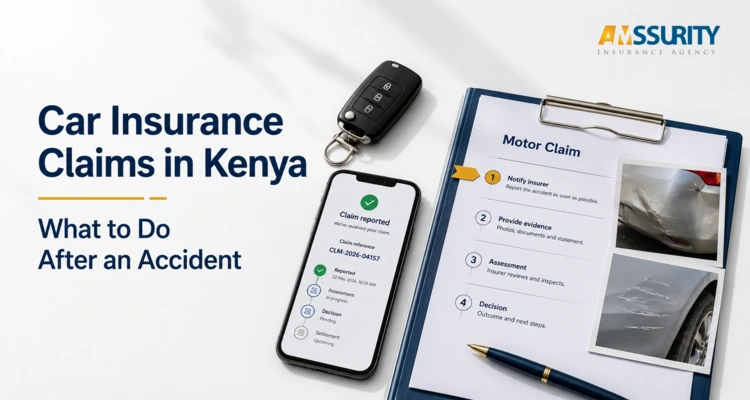
Understanding how car insurance claims in Kenya work can prevent avoidable delays after an accident, theft or vehicle damage. The outcome of a claim depends on the cover purchased, the circumstances of the loss, the documents available and whether the policy conditions were followed.
This guide explains the car insurance claims process, the documents you may need, how excesses affect payment and when a delayed or disputed claim may require escalation.
Table of Contents
Which car insurance claim route applies?
The correct route for car insurance claims in Kenya depends on what happened and the cover shown on the policy schedule.
| What happened? | Cover that may respond | What to do first |
|---|---|---|
| Your vehicle was damaged in an accident | Comprehensive | Notify the insurer, preserve evidence and wait for repair authorisation. |
| You damaged another person’s vehicle or property | The third-party section of the policy, subject to its limits | Do not admit liability. Report the incident and submit the third-party details. |
| Another driver damaged your vehicle | The other driver’s insurer or your comprehensive policy | Collect the driver’s insurance details and notify your insurer. |
| Your vehicle was stolen | Comprehensive or Third Party, Fire and Theft | Report the theft to the police and insurer immediately. Preserve all keys and documents. |
| Your vehicle was damaged by fire | Comprehensive or Third Party, Fire and Theft | Notify the insurer and obtain the required police or fire documentation. |
| Another person was injured or died | Third-party bodily injury liability, subject to the policy and applicable law | Obtain emergency help, report the accident to the police and notify the insurer promptly. |
| The vehicle was being used for Uber, Bolt or commercial work | Only cover that expressly permits that use | Notify the insurer, provide requested trip records and confirm that the policy permits the vehicle’s use. |
What should you do immediately after an accident?
- Protect life and prevent further loss. Move to safety where possible, arrange medical assistance and avoid actions that could worsen the damage.
- Do not admit liability or negotiate a private settlement at the scene. Record the facts without accepting blame or promising payment.
- Collect evidence. Photograph the vehicles, damage, road position, number plates, surroundings and relevant road signs.
- Exchange details. Record the other driver’s name, telephone number, registration number and insurance details where available.
- Record witnesses. Obtain names and contact details from anyone who saw what happened.
- Report the incident where required. Accidents involving injury, death, serious damage, theft or suspected criminal conduct should be reported to the police. Your insurer may require police documentation.
- Notify your insurer or intermediary promptly. Follow the notification period and method stated in your policy.
How do car insurance claims in Kenya work?
Although car insurance claims vary by loss type, most follow the stages below.
- Notification: The loss is reported and a claim reference is issued.
- Document collection: The insurer requests the records relevant to the claim.
- Assessment: An assessor, investigator or other specialist may inspect the vehicle and review the circumstances.
- Policy and liability review: The insurer checks whether the event is covered and whether policy conditions were met.
- Decision: The insurer may authorise repairs, offer a settlement, request more information or decline the claim with reasons.
- Discharge and payment: Where required, the insured signs a settlement document before payment.
The exact process varies. Theft, total-loss, bodily-injury and third-party claims may involve additional assessment or investigation.
Which documents may be required for a car insurance claim?
The documents required for car insurance claims in Kenya depend on what happened, the cover purchased and whether another person was involved. The insurer may request additional information after reviewing the initial notification.
| Claim type | Documents commonly requested | Important note |
|---|---|---|
| Accidental damage to your vehicle | Completed claim form, driver’s licence, police abstract where applicable, photographs, repair estimate, logbook and assessor’s report. | Do not authorise permanent repairs before the insurer or assessor approves them. |
| Vehicle theft | Claim form, police abstract or investigation report, logbook, all available keys, driver’s licence and a statement explaining the circumstances. | The insurer may also request recovery records, tracking information or proof of security measures. |
| Fire damage | Claim form, police or fire report where applicable, photographs, logbook and assessment report. | The insurer may investigate the cause of the fire before confirming liability. |
| Third-party property damage | Claim form, police abstract where applicable, photographs, third-party demand letter, repair estimates and details of the other vehicle or property. | Do not admit liability or negotiate a settlement without the insurer’s approval. |
| Third-party injury or death | Police records, medical reports, treatment records, witness statements, demand documents and identification records. | These claims may require further investigation and legal review. |
| Ride-hailing or commercial-use claim | Standard claim documents plus trip records, platform records, employment details or proof of declared vehicle use. | The vehicle use at the time of the incident must be permitted by the policy. |
| Windscreen or minor insured damage | Photographs, replacement quotation, claim form or simplified notification, depending on the insurer. | Some insurers use a shorter process where the damage falls within a specified policy limit. |
Not every document is required for every claim. Ask the insurer or intermediary for a written list that matches your case.
Not every document listed above is required in every case. Ask the insurer or intermediary for a written list that matches the specific claim.
How do excesses and deductions affect payment?
An excess is the portion of an admissible claim payable by the insured. A policy may contain a standard excess and additional excesses for circumstances such as young drivers, theft or use outside agreed terms.
Other adjustments may arise from:
- Underinsurance or an incorrect insured value.
- Betterment, where repairs improve the vehicle beyond its pre-loss condition.
- Uninsured accessories or modifications.
- Outstanding premium where the policy permits deduction.
- Salvage arrangements in a total-loss settlement.
- Policy limits, sublimits and exclusions.
The insurer should explain the basis of any deduction.
How long do car insurance claims take?
There is no fixed timeline for every motor claim. The duration depends on the documents submitted, assessment, liability issues and any investigations.
Under Kenya’s Insurance Act, an insurer must generally determine liability and pay within 90 days of the claim being reported once the relevant documents have been submitted. Straightforward claims may be completed sooner.
Why are claims delayed, reduced or declined?
Common issues include:
- Missing or inconsistent documents.
- Late notification that prejudices investigation or breaches the policy.
- Vehicle use outside the declared class, such as private cover used for ride-hailing.
- An unlicensed, unauthorised or ineligible driver.
- Material non-disclosure or incorrect information.
- Driving under the influence, subject to the wording and evidence.
- Lapsed cover or unmet premium conditions.
- Fraud, staged loss or exaggerated damage.
- Wear and tear, mechanical failure or another excluded cause.
A decline should be based on the policy wording, facts and evidence. Ask for the decision and the specific clause relied upon in writing.
What should you do if a claim is delayed or disputed?
- Request a written status update. Ask what stage the claim has reached, what is outstanding and who must act next.
- Request the written decision. Ask for the reasons and policy clauses relied upon.
- Use the insurer’s internal complaints process. Keep copies of all correspondence and supporting documents.
- Escalate to the Insurance Regulatory Authority where appropriate. The IRA receives written complaints involving liability, settlement amounts and delays in payable claims.
- Review the dispute-resolution clause. Arbitration applies only where the contract contains an applicable arbitration agreement.
- Seek legal advice where necessary. The appropriate forum depends on the amount, subject matter and nature of the dispute. It should not automatically be described as a High Court matter.
Where should you report your claim?
Policy taken through Amssurity: Report the incident promptly. We can explain the required documents, follow up with the insurer and help you track the claim where Amssurity services the policy.
Policy taken elsewhere: Contact the insurer or intermediary shown on your policy schedule. Amssurity cannot take over another intermediary’s active claim, but we can review the cover before your next renewal.
Car insurance claims FAQs
Quick answers to common questions about reporting, repairs and claim follow-up.
Must every accident be reported within 24 hours?
Not always. Notify your insurer promptly and within the period stated in your policy. Police-reporting requirements depend on the accident.
Can I repair the vehicle before the insurer inspects it?
Only with the insurer’s approval, except for emergency action needed to prevent further damage or protect safety. Keep photographs and receipts.
What should I ask for after a claim is declined?
Ask for the written decision, reasons, policy clause relied upon and details of the complaints process.
How can I follow up on car insurance claims in Kenya?
Ask for the claim reference, current stage, outstanding requirements, next action and expected review date. Keep the response in writing.
Review the cover before the next claim
The right time to check driver restrictions, vehicle-use conditions, excesses, theft requirements and optional benefits is before a claim happens.
Compare your motor insurance options with Amssurity before renewal and get a plain-English explanation of what the policy is designed to pay, what remains with you and which conditions could affect a future claim.
Originally published: 16 March 2021
Last reviewed: 17 July 2026

Founder & Insurance Advisor | Amssurity Insurance Agency, an IRA-licensed agency in Nairobi
Agnes Mukulu advises individuals, families, SMEs and diaspora Kenyans on health, motor, business, life and international medical insurance. Having reviewed hundreds of policies, quotations and benefit schedules, she helps clients look beyond premiums to understand benefits, exclusions, waiting periods, excesses and claims requirements. She founded Amssurity to make insurance guidance clearer, more transparent and more practical, helping clients choose suitable cover and understand how it should work when they need it most.